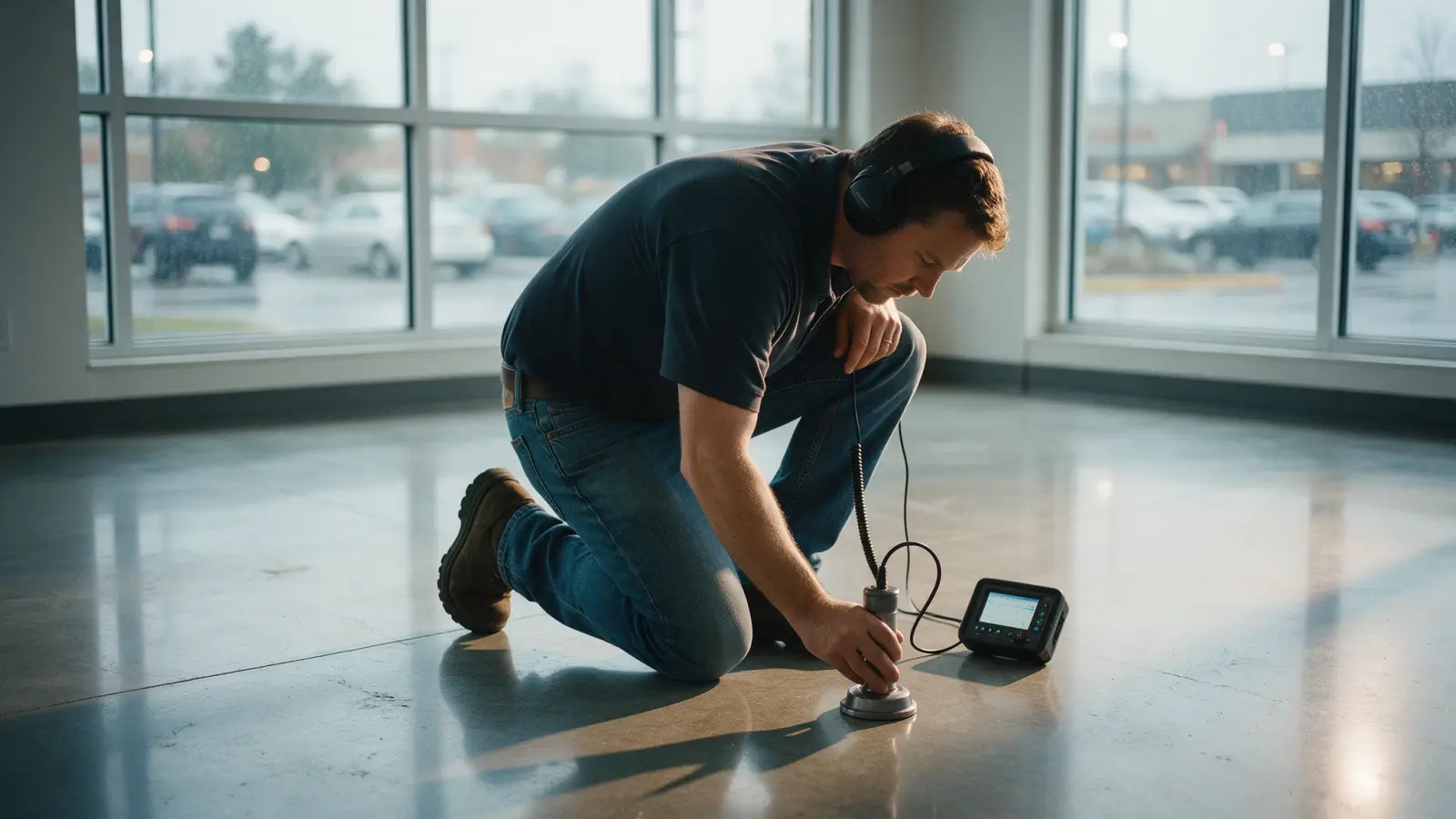
What is acoustic and tracer gas leak detection?
These are the two main ways to pinpoint a leak on a pressurized pipe you can't see: a water service line under a parking lot, a supply line under a slab, a buried irrigation main or a hydronic line in a trench. Both narrow a leak from "somewhere on this line" to a small area, so the repair needs one small, targeted opening instead of a long trench or a jackhammered floor.
Acoustic detection listens for the leak. Water forced out of a small hole under pressure makes a hissing noise that travels along the pipe and up through the ground. Sensitive microphones and sensors pick it up and help locate where it's loudest. Tracer gas detection follows the leak instead. The line is drained and filled with a safe gas mixture, and a sensitive detector picks up the gas as it rises through soil, asphalt or concrete above the break.
Specialists often use both. Acoustic methods are fast on metal pipes with good pressure. Tracer gas takes over where the leak is too quiet, the pipe is plastic, or background noise drowns out the sound.
How do acoustic and tracer gas methods compare?
| Factor | Acoustic | Tracer gas |
|---|---|---|
| How it works | Listens for the sound of escaping water. | Detects gas escaping from the drained pipe. |
| Line in service? | Yes, needs water under pressure. | No, the line is drained and filled with gas. |
| Best pipe types | Metallic pipe carries sound well. | Works on plastic and metal alike. |
| Small, quiet leaks | Harder to hear. | Often still detectable. |
| Noisy sites | Traffic and equipment noise interfere. | Not affected by noise. |
How are leaks pinpointed with sound and gas?
Ground microphones
The technician follows the traced pipe route and sets a ground microphone on the surface every few feet, comparing the leak noise at each point. The sound peaks above the leak. Filters cut out traffic, wind and HVAC noise, and the work is often done at night when sites are quietest.
Leak noise correlators
Two sensors are attached to the pipe at accessible points such as valves, meters, hydrants or exposed fittings. The leak sound reaches each sensor at a slightly different time. Knowing the pipe's length, material and diameter, the correlator calculates where between the sensors the leak must be. It's especially useful on long service lines, where walking the whole route with a microphone would take hours.
Noise loggers
On large campuses, small loggers can be left on valves overnight to record noise patterns, flagging sections that may hold a leak for follow-up pinpointing.
Tracer gas
The leaking line is isolated and drained, then filled at low pressure with a non-toxic, non-flammable mixture, commonly about 5% hydrogen in nitrogen. Hydrogen is the smallest molecule. It passes quickly through soil, cracks in asphalt and concrete. The technician walks the route with a detector probe and finds the spot where the gas comes up. Concrete floors are sometimes tested through small drilled holes or at joints.
Confirming before digging
A good specialist cross-checks the result with a second reading or method, marks the spot and depth, and explains how confident the location is. Utility locates are still needed before any excavation.
A typical sequence on a commercial site
On a retail center with a long service line, a specialist might start at the meter with a closed-valve test to confirm the loss, trace the line with a locator to paint its route, then run a correlation between the meter and the building shutoff. If the correlator shows a clear peak, ground microphones confirm the spot. If the line is plastic and the correlation is vague, the line is drained and gassed instead. Either way, you finish with one paint mark and a depth estimate, not a guess. That's what keeps a repair to a single small excavation and a quick patch of asphalt rather than a trench across the parking lot.
When is acoustic or tracer gas detection needed?
- A meter test confirms a leak, but nothing is visible.
- The suspect line runs under paving, buildings or landscaping.
- A warm floor area suggests an under-slab hot water leak.
- Wet ground appears, but water may be traveling from somewhere else.
- Water bills have risen steadily over several months.
- You can hear water running in walls or floors when nothing is on.
- A pressure test shows a line losing pressure.
- A long private service line with no record of its exact route.
What affects how accurate the location is?
- Pipe material. Metal carries leak sound well. Plastic dampens it, often making tracer gas the better choice.
- Pressure and leak size. Low pressure and very small leaks make less noise.
- Depth and surface. Deep lines and thick concrete or asphalt weaken sound and slow gas.
- Background noise. Traffic, pumps, HVAC and running water elsewhere can mask leak sounds.
- Accurate route. Knowing exactly where the pipe runs is essential. A leak search starts with locating the line.
- Soil conditions. Saturated soil can carry gas sideways, and very dense soil slows it.
How can you prepare for leak location?
- Run a meter test with all fixtures and irrigation off to confirm and document the leak.
- Gather site plans, utility drawings or as-builts that show the line route.
- Identify access points: meters, valves, cleanouts, hose bibs and exposed piping.
- Plan for a quiet period. After hours or weekends give better acoustic results.
- Let tenants know if water will be shut off for a tracer gas test.
Pro tip: turn off the noise
Ask for irrigation, fountains and noisy equipment to be off during acoustic testing. Even distant running water can confuse the readings.
Warning: don't dig where it's wettest
Water follows trench backfill and slopes. The wettest ground is often not above the leak. Locate first, then dig.
What happens during a leak location visit?
- Leak confirmationMeter and pressure tests confirm which line is leaking.
- Line tracingAn electronic locator marks the pipe route on the surface.
- Acoustic surveyGround microphones and correlators narrow the location.
- Tracer gas if neededThe line is drained and filled with gas for quiet or plastic lines.
- Pinpoint and markThe leak spot and approximate depth are painted on the surface.
- HandoverFindings are shared with the repair crew, along with the access options.
What affects the cost of leak location?
| Factor | Effect on the job |
|---|---|
| Line length | Long service lines and campus loops take longer to survey. |
| Method | Tracer gas adds draining, gas and refilling time. |
| Site noise | Busy sites may need after-hours work. |
| Unknown routes | Tracing an undocumented line comes first. |
| Multiple leaks | Older lines can have more than one leak. |
What if the leak is large and obvious?
When water is gushing to the surface, a building has lost water, or pavement is collapsing, the priority is shutting off the line and making the site safe, not fine-tuned detection. Close the main or curb stop, barricade the area and call for emergency commercial leak repair. Location tools can still help when water surfaces far from the actual break.
Undermined pavement
A large leak can wash out soil under asphalt. Keep vehicles and people off sinking or cracked areas.
Acoustic and tracer gas FAQ
Is tracer gas safe?
The common hydrogen-nitrogen mixture used for leak detection is non-toxic and non-flammable at that concentration, and it dissipates quickly in open air.
How close can they get to the leak?
In good conditions, typically close enough for a small, targeted excavation. Depth, pipe material and site noise affect accuracy.
Will the water be shut off?
Acoustic testing works with the line in service. Tracer gas needs the line drained, so plan a short shutdown.
Can these methods find leaks under a slab?
Yes. They're the standard tools for pinpointing under-slab supply leaks. See slab leak detection and repair for the full process.
Do they work on fire sprinkler lines?
The methods can locate leaks on buried fire service lines, but work must be coordinated with your fire protection contractor and alarm monitoring, since the system may need to be impaired.
Can they find drain leaks too?
Drains aren't pressurized, so camera inspection, smoke and dye testing are used instead. See sewer and drain line repair.
Related services and areas
Long private service lines in hillside and HOA settings on Norway Hill and around Brickyard Road–Queensgate are where buried leak location saves the most digging. Once the leak is marked, repairs follow under commercial main water line repair. For every other type of leak, see commercial leak repair in Bothell.