What is a commercial slab leak?
A slab leak is a leak in a pressurized water line that runs under or inside a concrete floor slab. Many commercial buildings, especially single-story retail, restaurants, clinics and slab-on-grade offices, run domestic cold water, hot water and hot-water recirculation lines under the floor to reach restrooms, kitchens and sinks. When one of those lines develops a pinhole or a failed joint, water escapes under the concrete, under pressure, around the clock.
Slab leaks are easy to miss because the concrete hides them. The water may drain away into the soil for months, showing up only as a higher water bill. Or it may come up through cracks, joints and flooring somewhere unexpected. Slab leak detection and repair means confirming there's a leak, figuring out which line it's on, pinpointing it to within a small area, and then deciding whether to dig down to it, go around it, or line the pipe from inside.
A slab leak is water leaving a pipe. Groundwater coming up through the floor or walls is a different problem with different fixes, covered under concrete and foundation leak repair.
How are slab leaks found?
Confirm the leak at the meter
With every fixture, ice machine, irrigation zone and process connection off, the water meter should stop. If its low-flow indicator keeps turning, water is going somewhere. That confirms a leak but doesn't locate it.
Isolate the line
Next the specialist narrows it down. Cold, hot and recirculation systems are shut off and tested separately. Branch valves are closed one at a time. A line that won't hold pressure on a test gauge is the leaking one. Hot-water leaks are common under slabs because heat and expansion stress the pipe and joints, and they often show up as a warm spot on the floor.
Pinpoint the location
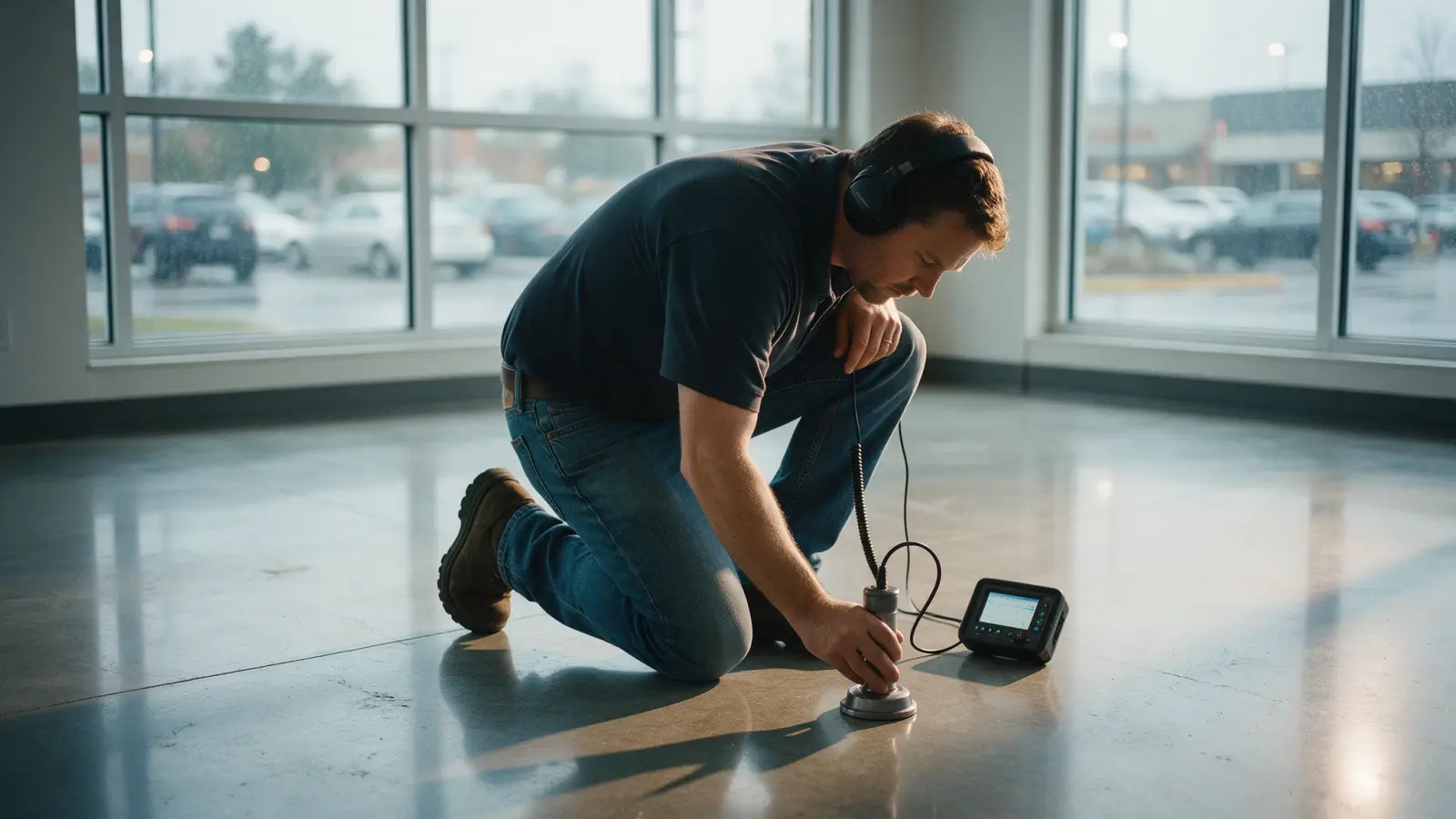
Once the leaking line is known, its route is traced with a pipe locator, and the leak is pinpointed with acoustic and tracer gas detection. Ground microphones pick up the hiss of water escaping under pressure through the concrete. If the line is too quiet, it's drained and filled with a safe tracer gas that rises through the slab where the pipe is broken. Thermal cameras can help on hot lines by showing warm trails across the floor.
What are the repair options for a slab leak?
Once the leak is pinpointed, there are three main ways to fix it, and the right one depends on the pipe's overall condition, the floor finish and how much disruption the business can tolerate.
| Option | How it works | Best when |
|---|---|---|
| Spot repair | A small section of slab is saw-cut and excavated, the failed pipe section replaced, then the concrete and flooring restored. | The rest of the pipe is in good shape and the floor can be opened. |
| Reroute | The under-slab line is abandoned and new piping runs through walls or ceilings to the same fixtures. | The line has had repeat leaks or is corroded along its length. |
| Epoxy lining | The pipe is dried, cleaned inside, and coated with epoxy that seals pinholes and adds a new barrier. | The pipe is intact enough to line and access to the floor is very limited. |
A good specialist explains why one option fits your building and puts the reasoning in writing, including what the other options would have involved.
What are the warning signs of a slab leak?
- A water meter that keeps moving with every fixture off.
- A water and sewer bill that jumps with no change in use.
- A warm spot on the floor, often along a hot water route.
- Damp carpet tiles, cupping wood, or loosening vinyl far from fixtures.
- The sound of running water when nothing is in use, usually quietest after hours.
- Water heaters running more than they used to.
- Musty smells or mold at the base of walls on the ground floor.
- New cracks in the floor or moisture around expansion joints.
What causes slab leaks?
- Pipe corrosion. Copper lines can pit from water chemistry and high velocity, especially on hot-water recirculation loops.
- Abrasion. Pipes rubbing against concrete, rebar or gravel as they expand and contract wear through over time.
- Poor original installation. Kinked tubing, bad joints, or pipe laid directly against sharp fill.
- Ground movement. Soil settlement and seismic movement shift the slab and stress the piping inside and under it.
- Thermal expansion. Hot water lines expand and contract every cycle, fatiguing joints and fittings.
- High water pressure. Pressure above what the system is designed for, or water hammer from fast-closing valves, stresses pipes and joints.
What can you check before calling?
- Turn off every fixture and water-using appliance, then watch the meter's low-flow indicator for several minutes.
- If your building has separate hot water, close the water heater's cold inlet valve and recheck. If the meter stops, the leak is likely on the hot side.
- Walk the floor barefoot or with the back of your hand to feel for warm spots along fixture routes.
- Compare water bills over the past year to see when usage jumped.
- Check toilets, urinals and faucets for running water first. They're a common hidden "leak."
Pro tip: test after hours
Run your meter check after closing, when ice machines, dishwashers and irrigation are off and the building is quiet. The results are much clearer.
Warning: don't start jackhammering
Breaking concrete to "look for" a slab leak can damage pipes, post-tension cables, radiant tubing or electrical conduit. Locate first, then open the smallest area possible.
What happens during the specialist's visit?
- Meter and fixture checkConfirm the leak and rule out running fixtures and equipment.
- System isolationSeparate cold, hot and recirculation lines and test each for pressure loss.
- Line tracingLocate and mark the path of the leaking line across the floor.
- PinpointingAcoustic listening, tracer gas or thermal imaging narrows the leak to a small area.
- Repair recommendationSpot repair, reroute or lining, with access, downtime and cost compared.
- Repair and verificationThe line is repaired, pressure-tested and the meter checked again before floors are closed.
What affects the cost of slab leak repair?
| Factor | Effect on the job |
|---|---|
| Detection difficulty | Quiet lines and deep or thick slabs take longer to pinpoint. |
| Repair method | Spot repair, reroute and lining each have different labor and materials. |
| Floor finish | Tile, polished concrete and specialty floors cost more to restore. |
| Slab construction | Post-tensioned slabs need scanning before any cutting. |
| Business impact | After-hours work and phasing to keep a space open. |
When is a slab leak an emergency?
Water coming up through the floor, a hot spot hot enough to be uncomfortable, or flooring that's lifting as water spreads all call for fast action. Shut off the main water valve, or the affected branch if you know it, and turn off the water heater if the leak is on the hot side. Then call for emergency commercial leak repair.
Post-tensioned slabs
Many commercial slabs contain tensioned steel cables. Cutting one is dangerous and costly. Any opening must be scanned and laid out by experienced crews.
Slab leak FAQ
How accurate is slab leak detection?
With good equipment and an experienced technician, leaks are typically narrowed to a small area of floor. Accuracy depends on slab thickness, floor covering, background noise and how much water is escaping.
Will my business have to close?
Often not. Detection is quiet work. Repairs can frequently be scheduled after hours or in phases, and reroutes through walls and ceilings can avoid floor work altogether.
Is rerouting better than fixing the spot?
If the pipe is otherwise sound, a spot repair is fine. If it's had more than one leak or shows corrosion, rerouting avoids chasing the next pinhole under the same floor.
Does insurance cover slab leaks?
Policies vary. Some cover the cost of accessing the pipe and the resulting water damage but not the pipe repair itself. Check your policy and document the leak before repairs begin.
Can a slab leak damage the foundation?
A long-running leak can wash out or soften the soil under the slab and contribute to settlement or cracking. Finding it early limits that risk.
What about leaking drain lines under the slab?
Drain lines aren't pressurized, so they're found differently, usually with a camera and sometimes a flow test. See sewer and drain line leak repair.
Related services and areas
Slab-on-grade retail and restaurant buildings around Thrasher's Corner and along the West Bothell corridor are typical places for under-floor line leaks. For an overview of every kind of leak, see Bothell leak detection and repair. If the leak might be on the service line outside, check commercial main water line repair.