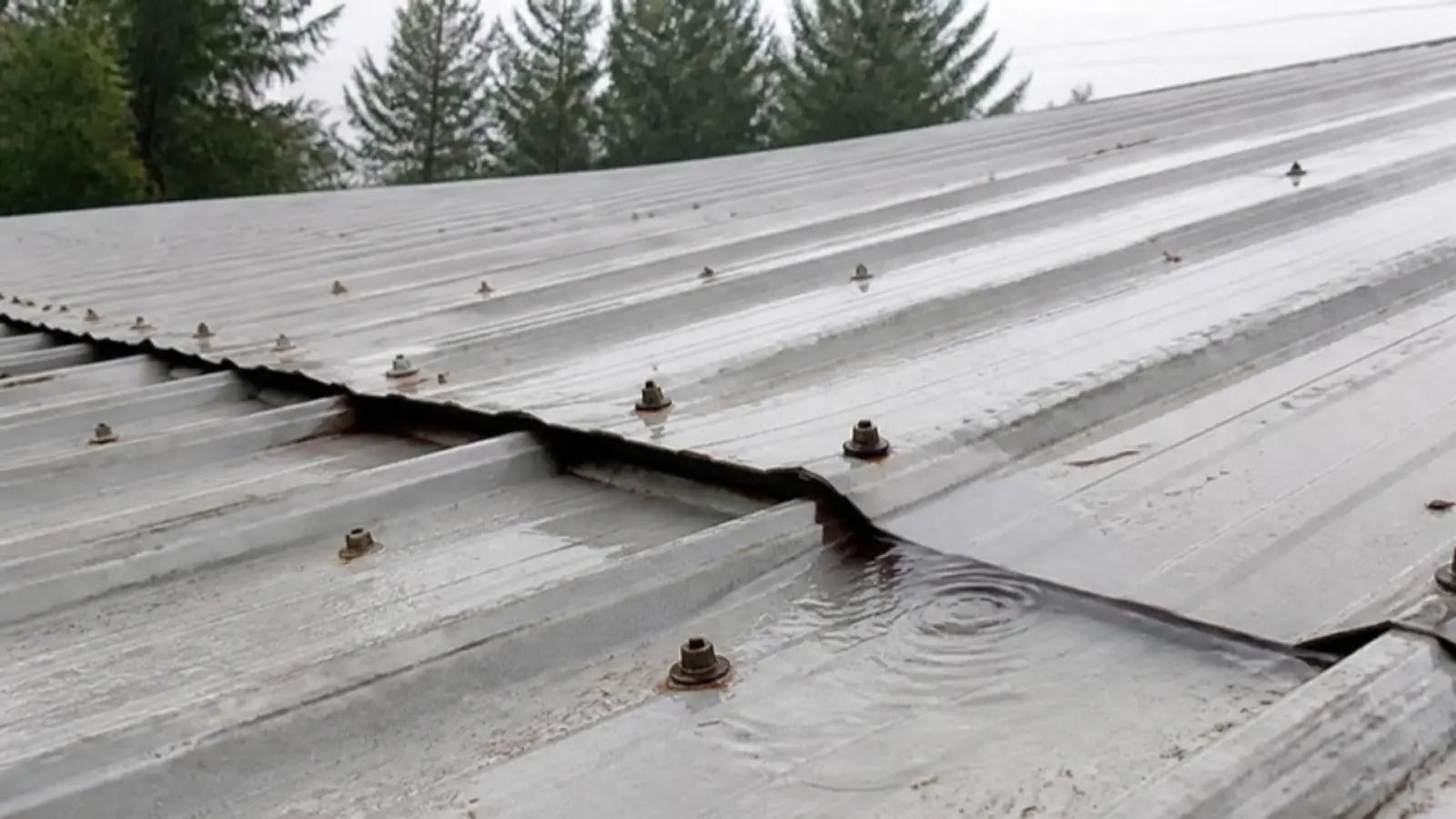
What does metal roof leak repair involve?
Metal roof leak repair fixes the points where water gets past steel or aluminum roof panels. That means the fasteners, the laps where panels overlap, the trim at ridges and eaves, and every opening cut for skylights, vents and equipment. The panels themselves rarely fail first. A metal roof is a system of thousands of small joints, and leaks almost always come from those joints.
Commercial metal roofs come in two main types. Through-fastened (exposed-fastener) panels, common on warehouses, shops and pre-engineered buildings, are screwed straight through into the purlins. Every screw relies on a rubber washer to seal. Standing seam roofs use concealed clips and raised, locked seams, so there are far fewer holes, but the seams, end laps and trim still need to stay sealed. Each type has its own repair methods, and using the wrong one can make things worse.
How are metal roof leaks repaired?
Fastener replacement
On exposed-fastener roofs, aged screws are removed and replaced with new ones, often one size larger so they grip in holes that have worn oval. New sealing washers go under them. Overdriven screws, which crush the washer, and underdriven ones, which never compress it, are both corrected.
Lap and seam sealing
End laps and side laps are opened or cleaned, then resealed with butyl tape or sealant made for metal roofing and re-fastened to pull the joint tight. On standing seam roofs, a seam that has lifted is re-crimped or re-seamed with the right tool, and failed sealant at end laps and trim is cut out and replaced.
Trim, closures and penetrations
Ridge caps, eave trim and foam closures keep wind-driven rain out of panel ribs. Missing or crushed closures are replaced. Pipe penetrations get a proper flexible boot instead of a sealant bead. Rooftop equipment added after construction may need a factory-style curb with a diverter, so water flows around it instead of piling up behind it.
Panels, skylights and coatings
Badly rusted or creased panels are swapped out. Cracked or yellowed translucent skylight panels are replaced with matching profiles. When a sound roof has many tired fasteners and laps, a coating system that reinforces the seams and covers every screw head can be an alternative to replacing each one, as long as rust is treated first.
Is it a leak or condensation?
Metal buildings "sweat." When warm, moist indoor air hits the cold underside of the panels, water condenses and drips, often on cool, damp nights common in western Washington. It looks exactly like a leak. Getting this right first saves money on repairs the roof doesn't need.
| Clue | Points to a leak | Points to condensation |
|---|---|---|
| Timing | During or right after rain | Cold, clear mornings, even when dry |
| Location | The same spots each time, often under laps or screws | Spread widely across the ceiling area |
| Insulation facing | Wet in one area | Torn or missing facing, wet in many places |
| Building use | Any use | Washing, cooking, unvented heaters, lots of people |
If it's condensation, the fix is a repaired vapor retarder, better ventilation or controlled humidity, not roof work.
What are the warning signs of a metal roof leak?
- Screws backing out, tilted, or with cracked or missing washers.
- Rust streaks running downslope from screws, laps or cut panel edges.
- End laps that have separated or show dried, cracked sealant.
- Ridge caps or eave trim that's loose, bent or missing closures.
- Daylight visible from inside along laps or around penetrations.
- Cracked, yellowed or brittle translucent skylight panels.
- Water stains on insulation facing directly under laps or fastener lines.
- Standing seams that look lifted, open or out of line with the panels beside them.
What causes metal roofs to leak?
- Washer aging. The rubber washer under each exposed screw hardens and cracks with sun and time, long before the steel wears out.
- Thermal movement. Long panels grow and shrink through each day. On through-fastened roofs that movement wallows screw holes oval and loosens fasteners.
- Installation errors. Screws that miss the purlin, are driven at an angle, or are over- or under-tightened leak sooner.
- Corrosion. Cut edges, scratches and spots where dissimilar metals touch, like copper against steel, start rusting first. Wet leaves and moss sitting in the panel valleys speed it up.
- Add-on penetrations. Vents, conduits and equipment cut in after construction are often sealed with caulk alone.
- Low slope. Exposed-fastener panels on a very low pitch drain slowly, so laps sit in water.
- Wind. Gusts lift loose trim and drive rain sideways into ribs that are missing closures.
Where a metal roof meets a masonry wall or parapet, the leak may be in the wall flashing instead. See parapet wall and flashing repair.
What can you check safely yourself?
Metal panels are slick when wet and can be dented by walking in the wrong place. Unless you have safe access and fall protection, check from inside and from the ground.
- From inside on a dry day, look along laps and around penetrations for daylight.
- Note whether drips happen only in rain, or also on cold, dry mornings.
- Mark wet spots on the floor with tape, then look straight up for the screw line or lap above.
- From the ground, use binoculars to look for loose ridge caps, bent trim and rust streaks.
- Check gutters and valleys for packed leaves or moss holding water against the panels.
Pro tip: walk the purlin lines
Anyone who does go on the roof should step only where the screw rows run. Those mark the purlins underneath. Stepping mid-span can dent the panel and open nearby laps.
Warning: tightening every screw is not a fix
Cranking down old screws crushes brittle washers and can strip the purlin. Aged fasteners should be replaced, not over-tightened.
What happens during the specialist's visit?
- Inside lookThe specialist checks where water lands, the condition of the insulation facing, and whether condensation could be involved.
- Roof surveyA walk of the fastener lines, laps, trim and every penetration, photographing problem areas.
- Water test if neededA hose test on one lap or penetration at a time to confirm the entry point.
- RepairNew fasteners, resealed laps, replaced closures and trim, new boots or curbs.
- Rust treatmentCorroded spots are cleaned and primed, or panels replaced where the metal is too thin.
- ReportPhotos, notes on any wider fastener or lap problems, and options if a coating or retrofit system makes sense.
What affects the cost of metal roof leak repair?
| Factor | Effect on the job |
|---|---|
| Roof type | Exposed-fastener repairs differ from standing seam tooling and parts. |
| Scope | A few failed screws versus re-fastening whole rows or laps. |
| Corrosion | Rust treatment or panel replacement adds material and time. |
| Pitch & height | Steeper or taller roofs need more safety setup. |
| Matching parts | Older panel profiles and skylights can be harder to source. |
When does a metal roof leak need urgent help?
Get help right away when wind has peeled back panels or trim, when water is falling on electrical equipment, racking, or stock that can't be moved, or when a skylight panel has cracked open. Loose metal can tear off in the next gust and become a hazard. Call for emergency commercial leak repair to secure the roof and stop the water.
Never walk on translucent panels
Skylight panels on metal roofs won't hold a person's weight. Falls through them are a known serious hazard. Stay clear and keep others away.
Metal roof leak FAQ
How often do metal roof screws need replacing?
The rubber washers usually age out well before the panels do. Have fasteners checked during regular roof inspections, and plan to replace aging screws in sections before they start leaking everywhere at once.
Can a leaking metal roof be coated instead of repaired?
A coating can work on a sound roof once rust is treated, loose fasteners are replaced, and laps are reinforced. It doesn't fix structural problems or badly corroded panels. See roof coatings for how that decision gets made.
Why does my metal building drip when it isn't raining?
That's usually condensation. Moist indoor air hits the cold panels and condenses, especially where the insulation facing is torn or missing. Fixing the vapor retarder or ventilation solves it.
Is standing seam better than exposed-fastener for leaks?
Standing seam has far fewer holes, so it generally needs less fastener maintenance. But its seams, end laps and trim can still leak if they're damaged or poorly sealed.
Can one rusted panel be replaced on its own?
Usually, if a matching profile is available. The replacement has to lap correctly with the panels beside it, with new sealant and fasteners, so it sheds water the same way.
What about leaks around rooftop units on a metal roof?
Units added after construction often sit on curbs that block water flowing down the panel ribs. A properly flashed curb with a diverter on the upslope side is the lasting fix.
Related services and areas
Metal roofs are common on the warehouse and light-industrial buildings around Canyon Park, and on accessory buildings and newer storefronts in Downtown Bothell. Large plants with process equipment on the roof are covered under industrial and factory leak repair. For an overview of every leak type, see leak repair for Bothell businesses.