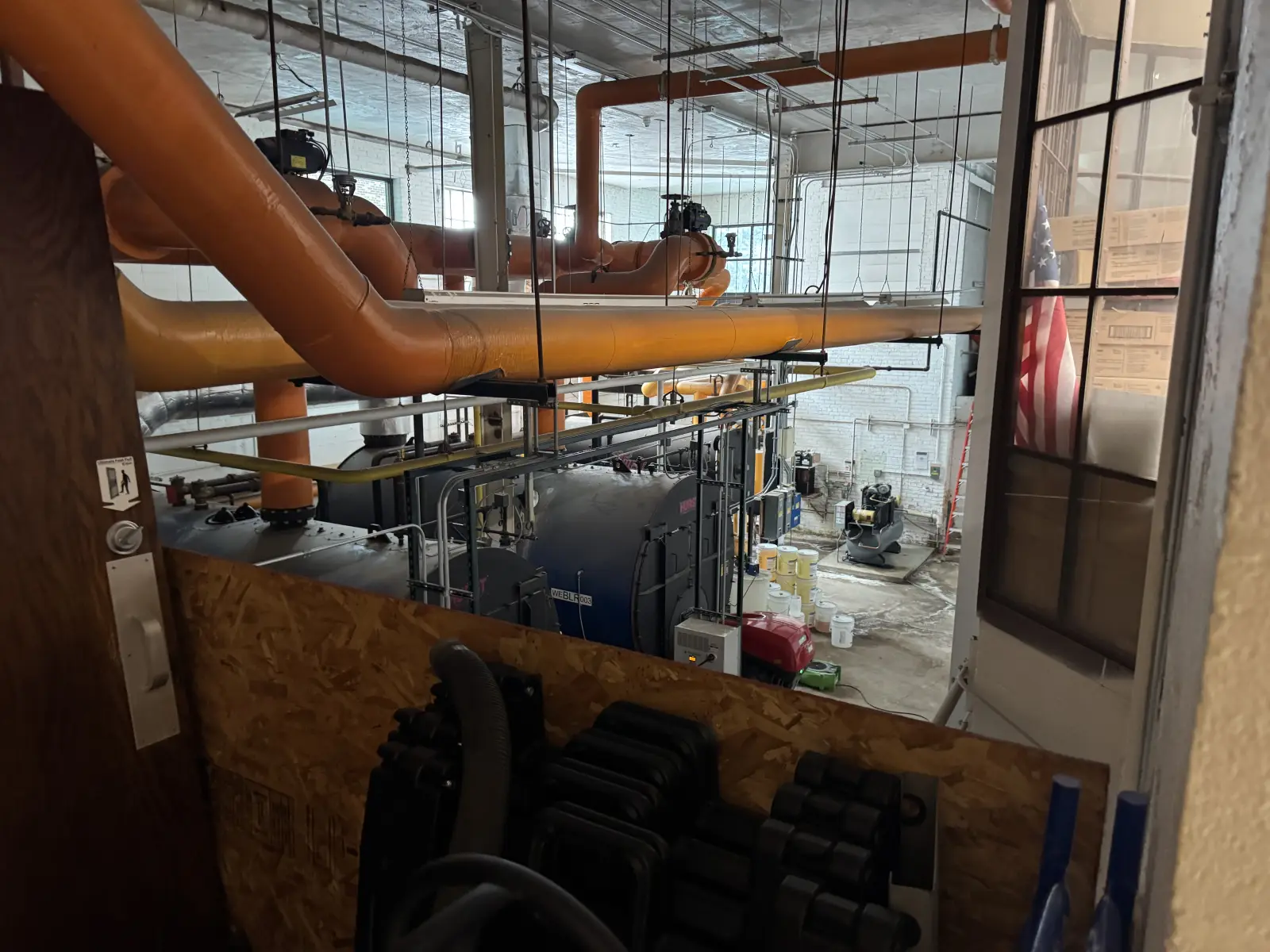
What is cooling tower and boiler leak repair?
Cooling towers and boilers are the two ends of many commercial central plants. A cooling tower rejects heat from the building's chiller by evaporating water as it trickles over fill media, with a basin collecting the cooled water at the bottom. A boiler heats water or makes steam for space heating and sometimes for kitchens, laundries or processes. Both handle a lot of water, both lose some of it by design, and both can hide a real leak inside that "normal" loss.
Cooling tower and boiler leak repair separates expected water use from actual leaks, then fixes the leaks: basin seams and corrosion, stuck makeup and float valves, overflow and blowdown problems, leaking boiler tubes or sections, pump seals and relief valves. These are pressure and treatment-sensitive systems, so repairs go hand in hand with water chemistry and the safety rules that apply to them.
Leaks in the piping that connects these machines to the rest of the building are covered under chilled water and HVAC pipe leak repair.
How do you tell a leak from normal water use?
A cooling tower is supposed to use water. It loses water to evaporation (the cooling itself), to blowdown or bleed (intentional draining to keep minerals from building up), and to a little drift, fine droplets carried out with the air. The makeup water line replaces all three. A leak is anything beyond that: water overflowing the basin, dripping from seams, or running to drain through a stuck valve.
A closed-loop boiler, on the other hand, should need very little makeup water. Steady makeup on a hot water boiler loop means water is leaving somewhere: a leaking tube or section, a pump seal, a relief valve discharging, or a leak elsewhere in the heating piping. Steam systems lose some water through condensate losses, but excessive makeup still points to leaks or failed steam traps.
| Loss | Normal? | What to look for |
|---|---|---|
| Tower evaporation | Yes | Rises with cooling load and hot weather. |
| Tower blowdown | Yes, if controlled | A blowdown valve stuck open sends treated water to drain all day. |
| Tower overflow | No | Water running out of the overflow pipe means the makeup valve isn't shutting off. |
| Boiler loop makeup | Minimal | Steady makeup means a leak in the boiler or the heating loop. |
| Relief valve discharge | No | Points to over-pressure, a waterlogged expansion tank or a failing valve. |
How are tower and boiler leaks repaired?
Cooling towers
- Makeup and float valves. Worn or stuck float valves and failed electronic makeup controls are rebuilt or replaced so the basin stops overfilling.
- Basin leaks. Corroded galvanized steel basins and seams are cleaned and sealed with basin coatings or seam sealants, or panels are replaced. Fiberglass cracks are repaired with compatible resins.
- Blowdown control. Stuck blowdown valves and faulty conductivity controllers are repaired so bleed matches the water treatment program.
- Drift eliminators and distribution. Damaged eliminators and clogged distribution nozzles are replaced to cut excess drift and splash-out.
Boilers
- Tube leaks. On fire-tube and water-tube boilers, leaking tubes are plugged or replaced by qualified boiler repair crews.
- Sectional boilers. Leaks between cast iron sections, often at push nipples or gaskets, may need section replacement.
- Relief valves and expansion tanks. A discharging relief valve is investigated, not capped. Expansion tanks and fill pressure are checked and the valve replaced if faulty.
- Pumps, valves and fittings. Leaking pump seals, valve packing and threaded connections are repaired at the boiler room.
Boilers are pressure vessels. In Washington they're subject to state inspection requirements, and repairs to pressure-retaining parts should be done by qualified repair organizations and documented for the inspector.
What are the warning signs of tower or boiler leaks?
- Water running from the tower overflow or down the tower casing.
- Tower makeup water use far higher than the cooling load explains.
- Rust streaks and corrosion on tower basin seams and legs.
- A boiler that keeps calling for makeup water or losing pressure.
- Puddles or white mineral crust around the boiler base.
- A relief valve that drips, spits or has water at its discharge.
- Visible spray or heavy drift blowing off the tower.
- Sooting, unusual noises or short-cycling on the boiler.
What causes cooling tower and boiler leaks?
- Corrosion. Towers are wet, aerated and full of minerals. Weak water treatment speeds up corrosion of basins and piping.
- Scale. Mineral buildup on boiler tubes causes overheating and tube failure.
- Mechanical wear. Float valves, pump seals and valve packing wear out with use.
- Thermal stress. Rapid temperature changes and short cycling stress boiler sections and tube sheets.
- Pressure problems. Waterlogged expansion tanks and incorrect fill pressure make relief valves lift.
- Freeze damage. Towers and makeup lines left wet and unprotected can freeze in cold snaps.
What can you check before calling?
- Read the tower and boiler makeup meters daily for a week and compare with weather and load.
- Look at the tower overflow pipe. Water running out of it means the basin is overfilling.
- Check boiler pressure and temperature gauges and note whether pressure drops between fills.
- Look for water at relief valve discharge piping, without touching hot surfaces.
- Ask your water treatment provider for recent test results and any notes on corrosion or scale.
Pro tip: ask about evaporation credits
Some utilities offer sewer charge credits for cooling tower water that evaporates instead of going to the sewer, usually based on separate metering. Ask your provider whether that applies to you.
Warning: never cap or plug a relief valve
A discharging relief valve is a symptom, not the problem. Blocking it can turn a boiler into a serious explosion hazard.
What happens during the specialist's visit?
- Water balance reviewMakeup readings are compared with load, blowdown settings and treatment records.
- Tower inspectionFloat and makeup valves, overflow, basin seams, piping connections and eliminators are checked.
- Boiler inspectionPressure, relief valve, expansion tank, pump seals and visible leak points are checked, with internal inspection if needed.
- DiagnosisNormal losses are separated from leaks, and failures ranked by water loss and safety.
- RepairsValves rebuilt, seams sealed, tubes plugged or replaced, seals renewed, all coordinated with shutdown windows.
- Restart and verifyThe system is refilled and treated, and makeup readings tracked afterward to confirm the fix.
What affects the cost of tower and boiler repairs?
| Factor | Effect on the job |
|---|---|
| Equipment type & size | Larger towers and boilers need more parts and crew time. |
| Shutdown window | Seasonal or after-hours scheduling to keep the building comfortable. |
| Corrosion extent | Seam sealing versus replacing basin panels or tubes. |
| Access | Rooftop towers may need cranes or special rigging. |
| Inspection needs | Pressure vessel repairs may require documentation and inspection. |
When is it an emergency?
A boiler leaking heavily, losing pressure fast, or with a relief valve discharging continuously needs to be shut down safely and checked right away. So does a tower flooding a roof or mechanical yard. Loss of heat in a cold snap can freeze other piping in the building. For uncontrolled water, call for emergency commercial leak repair, and follow your plant's shutdown procedures.
Steam and hot water burns
Keep people away from leaking boilers and steam piping. Escaping steam can be nearly invisible and cause severe burns.
Cooling tower and boiler FAQ
Why is my cooling tower using so much water?
Evaporation is normal and rises with load and heat. Unusually high use often comes from a stuck makeup valve feeding the overflow, a blowdown valve stuck open, or basin leaks.
Is a dripping boiler relief valve dangerous?
It means pressure is reaching the valve's setting or the valve is failing. Either needs prompt attention from a qualified technician. Never block the valve.
Can a corroded tower basin be repaired?
Often, yes. Cleaning and coating the basin and sealing seams can extend its life. Severely thinned or perforated panels may need replacing.
Do tower leaks affect Legionella risk?
Leaks and stagnant areas can undermine water treatment. Towers should be maintained under a water management program, and repairs coordinated with your water treatment provider.
How do I know if boiler tubes are leaking?
Steady makeup water, water in the firebox or combustion area, and white residue are common signs. Confirming it requires a shutdown and inspection.
When should a leaking boiler be replaced?
Repeated tube or section failures, heavy scaling or corrosion, and an old, inefficient unit all point toward replacement. The specialist can compare repair and replacement costs.
Related services and areas
Office, lab and light-industrial campuses in Canyon Park often run cooling towers and central boilers, and older buildings in Downtown Bothell may still heat with hot water or steam boilers. For other kinds of leaks, see our Bothell facility leak repair overview. Buried makeup lines are located with acoustic and tracer gas detection.