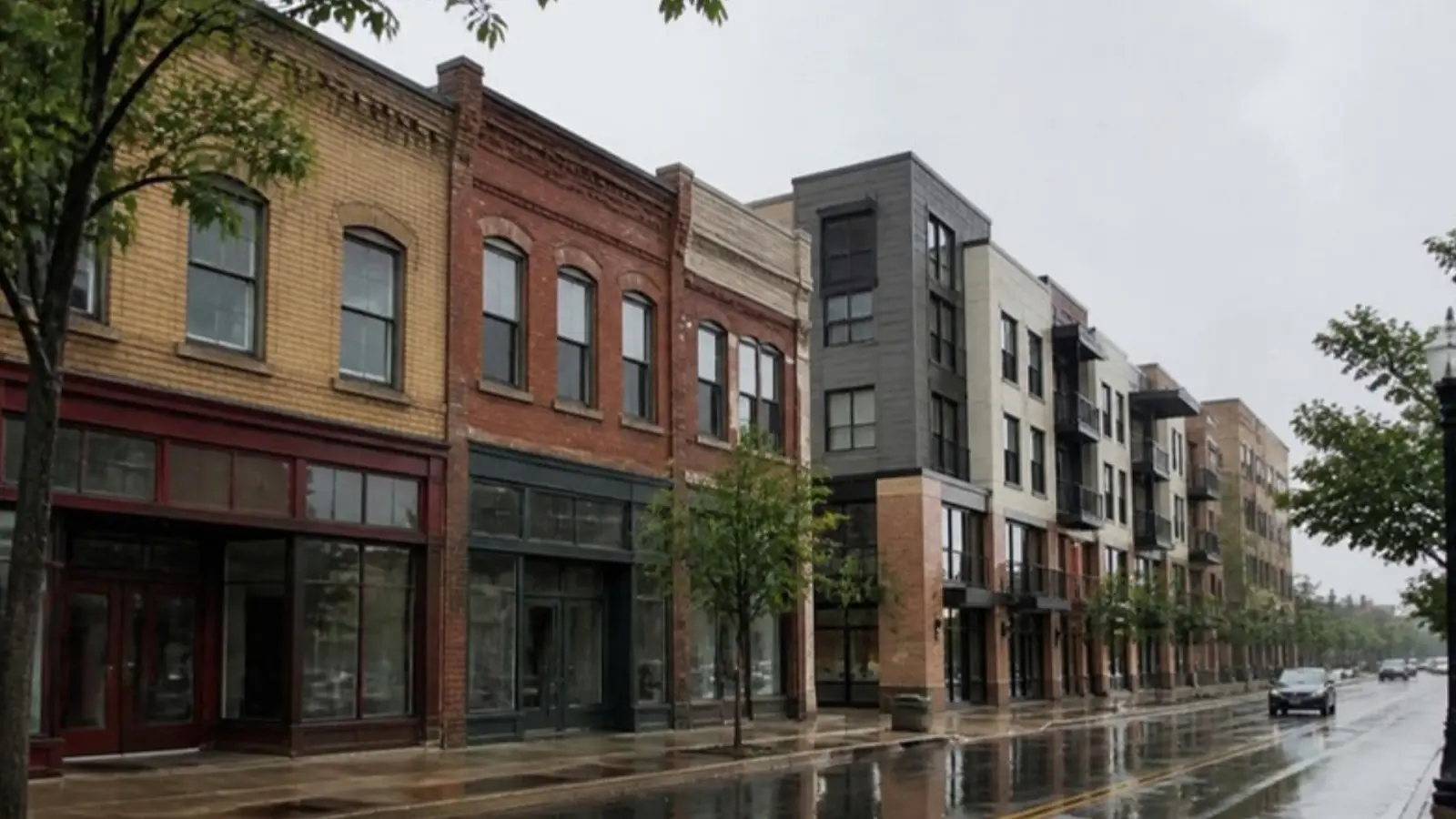
Older Main Street storefronts with brick parapets, busy restaurant kitchens, and newer mixed-use buildings with apartments over shops and garages. Get connected with a local specialist who handles old and new buildings side by side.
Why are downtown buildings a special leak challenge?
Older brick storefronts beside a newer mixed-use building on a rainy main street.
Downtown Bothell packs two very different generations of buildings into a few blocks. Along Main Street, older commercial buildings have masonry walls, brick parapets, storefront windows and roofs that have been patched and re-covered over the decades. Around them, newer mixed-use buildings stack apartments over ground-floor shops and restaurants, often on top of podium parking. The Sammamish River runs just south of the core.
Each generation leaks in its own way. Older buildings take water through parapet coping, open mortar joints and aging storefront frames, and their roofs often have layers of past repairs that hide where water really gets in. Newer buildings depend on waterproofing that's harder to see: podium deck membranes over garages, balcony waterproofing over units, and sealant joints across large panel facades. When those fail, water lands in someone's apartment, a restaurant dining room or a parked car.
Downtown is also restaurant country. Kitchens bring grease lines, floor sinks, ice machines and exhaust fans on the roof. All of them are leak sources that have to be handled around service hours and health inspections.
Real-world example
What a typical downtown leak call looks like
A shop owner on an older block reports a damp stain spreading at the top of the back wall every time it rains hard. The roof was re-covered a few years ago, so everyone assumes it's fine. The specialist goes up and finds the new membrane properly turned up the parapet, but the old coping above it has open joints and the brick below is soaking up water. Water runs down inside the wall and appears below the roof line. The fix is new coping joints with an underlayment beneath the coping and repointing of the worst mortar. The roof itself never needed touching.
Pro tip for older storefronts
If a leak shows up right at the top of an exterior wall, ask for the parapet and coping to be checked before anyone works on the roof membrane.
Mixed-use buildings and shared responsibility
In a building with apartments over shops, a single leak can involve a residential owner or tenant, a commercial tenant, the property manager and sometimes an association. Water from a balcony membrane can show up in a restaurant ceiling. A failed drain in a unit can stain a retail space two floors down. The fastest way through that tangle is an early, documented source investigation that everyone can see. Once the cause is clear, the lease, the governing documents and the insurers can sort out who pays, while the repair moves ahead instead of waiting on the argument.
Top services downtown
Which leak services do downtown properties need most?
Four services that match Main Street's older buildings and the new mixed-use blocks around them.
Parapet wall & flashing repair
Brick parapets and aging coping are the classic downtown leak. Parapet and flashing repair checks the coping, counterflashing, base flashing and masonry in order, and rebuilds the layer that failed.
Floor sinks, dish machines, walk-ins and grease lines leak on a restaurant's worst nights. Kitchen leak repair is scheduled around service and leaves the space clean.
Mixed-use buildings with parking under shops and apartments need tight deck joints and coatings. Garage waterproofing stops drips onto cars and into retail ceilings below.
Older buildings and busy kitchens share aging cast iron and clay drain lines. Sewer and drain repair starts with a camera, so you see exactly what's wrong before choosing a fix.
Look up at parapets from across the street for loose coping, cracked mortar and white staining.
Clear roof drains and scuppers on older roofs before the rainy season.
Schedule kitchen drain jetting and grease interceptor pumping on a regular cycle.
Check balcony and deck drains in mixed-use buildings each fall.
Walk the garage after heavy rain and note drips at joints above parked cars.
Keep storefront weep slots open, and ask painters not to seal them.
Know which tenant spaces share drain lines and shutoff valves.
Nearby
Which nearby areas do we also cover?
Downtown borders the hillside condo communities of Westhill, and the SR 522 corridor heads southwest into West Bothell. North, the office buildings along North Creek bring curtain walls and parking levels. For help with any type of building, start with Bothell building leak repair.
On older buildings, water often enters through the parapet coping or porous brick above the roof line, then runs down inside the wall. A new membrane doesn't fix that.
Can kitchen repairs be done after closing?
Usually, yes. Many providers schedule restaurant work late at night or early in the morning so you can open on time.
Water is dripping into our shop from the apartments above. Who fixes it?
Notify building management. The source may be a unit fixture, a shared line or deck waterproofing. A documented source decides who's responsible.
Are older cast iron drains worth lining?
If a camera shows cracks or rot but the pipe still holds its shape, lining can avoid tearing up floors in an occupied shop.
Can we keep the shop open during roof or parapet work?
Usually. Most roof and parapet work happens outside, and interior protection is only needed where ceilings are opened. Work near entries can be scheduled before opening hours.
Does being near the river matter?
Low-lying sites near rivers can see higher groundwater in wet months, which matters for basements and lower levels more than for roofs.
Downtown leak?
Get your storefront, kitchen or deck leak fixed
Call and describe the building, the space and where water shows up.