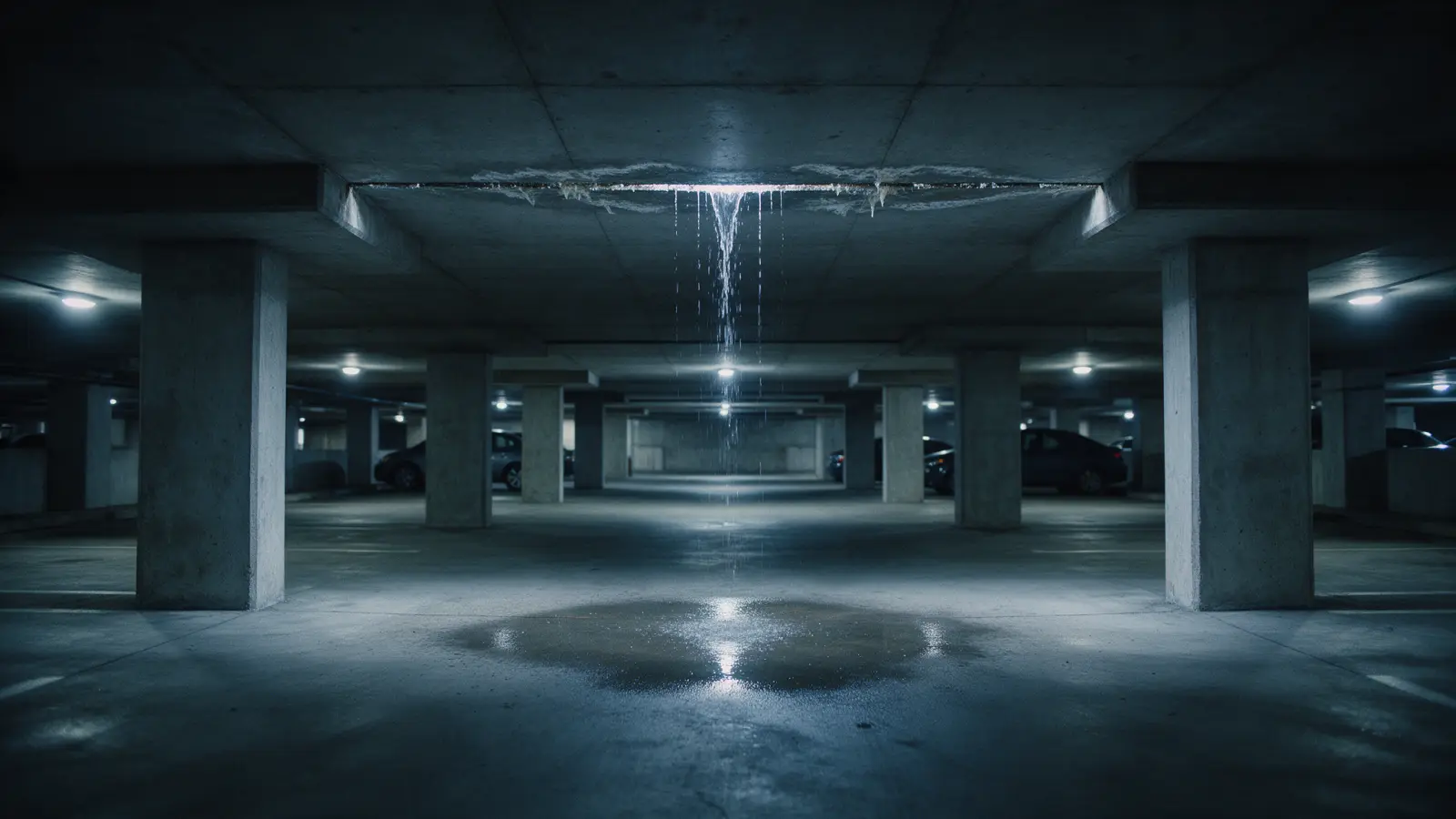
What is concrete and foundation leak repair?
Concrete and foundation leak repair stops groundwater and surface water from coming through the parts of a building that sit below or against the ground. That includes basement and lower-level walls, retaining walls that form part of the building, slab-on-grade edges, and the joints and penetrations through all of them.
Concrete is strong but not waterproof. It cracks as it cures and as the building settles, it has joints wherever one pour meets another, and it's full of small holes left by the ties that held the forms together. When soil around the building is saturated, water pushes on the wall with real pressure, called hydrostatic pressure, and finds every one of those openings. Repair means sealing the openings, and often reducing the water pressure itself with better drainage, so the fix lasts.
This service is about water coming in from the ground. Water escaping out of a pressurized pipe under the floor is a different problem, covered under slab leak detection and repair.
How are foundation leaks repaired?
Crack and joint injection
For leaking cracks and cold joints, the most common repair is injection from inside. Ports are set along the crack, and resin is pumped in until it travels through the full wall thickness. Polyurethane resins react with water and expand, filling the crack with a flexible seal that tolerates small movement. That makes them the usual choice for active leaks. Epoxy bonds the crack back together structurally, so it's used when strength matters and the crack is dry enough to bond.
Tie holes and penetrations
Form-tie holes, pipe sleeves and conduit penetrations are drilled out or cleaned and sealed with hydraulic cement, injection or a mechanical seal. Penetrations through walls under constant water pressure often get a link-seal or a sleeve-and-grout repair.
Negative-side and positive-side waterproofing
Positive-side waterproofing goes on the outside, the wet side of the wall. A membrane, drainage board and footing drain keep water away from the concrete entirely. It's the most effective approach but requires excavation. Negative-side treatments go on the inside: crystalline products that grow into the concrete's pores, cementitious coatings and interior drainage. They're used when the outside can't be reached, such as walls against a neighbor's building or under a sidewalk.
Drainage and pressure relief
Sometimes the best fix is less water. Repairing gutters and downspouts, regrading soil away from the wall, restoring footing drains, or adding an interior perimeter drain and sump pump can reduce the pressure behind the wall enough that sealing repairs hold.
Choosing the right combination
Few buildings need just one of these. A single leaking crack in an otherwise dry wall is a textbook injection job. A wall that weeps across its whole face, with efflorescence everywhere, has a water-pressure problem, and injection alone will chase leaks around the wall. That case needs drainage relief, a negative-side treatment or exterior work. A specialist should explain which situation you're in, and what result to expect from each option, before recommending one. If someone promises a bone-dry wall from a single product without looking at grading and drainage, ask more questions.
What are the warning signs of a foundation leak?
- Water seeping through wall cracks or along horizontal cold joints.
- White, chalky efflorescence on concrete or block walls.
- Rust-colored stains at form-tie holes in a grid pattern.
- Water at the joint where the wall meets the floor slab.
- Leaks that start a day or two after heavy rain and continue after it stops.
- Musty smells, mold on stored items, or peeling paint on lower-level walls.
- Water around pipe or conduit penetrations through the wall.
- A sump pump that runs constantly or more often than it used to.
What causes concrete and foundation leaks?
- Hydrostatic pressure. Saturated soil pushes water through any opening. Long Puget Sound rains keep soil saturated for weeks.
- Dense glacial soils. Much of the region sits on glacial till, which drains slowly. Water can perch on top of it and collect against foundation walls.
- Shrinkage and settlement cracks. Almost all concrete cracks. Cracks that reach through the wall become leak paths.
- Cold joints. Where one concrete pour meets the next, the bond is weaker and water finds the seam, especially without a waterstop.
- Failed exterior waterproofing. Damaged, aged or missing membranes and clogged footing drains let water reach the wall.
- Surface water. Short downspouts, broken gutters and soil sloping toward the building dump water at the foundation.
- Hillside sites. Buildings cut into slopes have uphill walls that collect water flowing through the ground.
What can you check before calling?
- Walk the outside during rain. Watch where downspouts discharge and where water collects along the building.
- Check whether the ground slopes away from the foundation or toward it.
- Mark the ends of active cracks with a pencil and the date, so you can tell whether they grow.
- Note how long after rain the leak starts. A quick response points to surface water, a slow one to groundwater.
- Check that the sump pump runs, discharges away from the building, and has a working alarm if it has one.
Pro tip: fix downspouts first
Extending downspouts and correcting soil slope costs little and can dramatically cut water at the wall. Do it before, or alongside, any injection work.
Warning: paint won't hold back groundwater
Ordinary "waterproof" paint on the inside of a wall under water pressure usually blisters and peels. It can also hide cracks that need real repair.
What happens during the specialist's visit?
- History and conditionsWhen it leaks, how much, and what changed recently: new paving, landscaping, a neighboring dig or new downspouts.
- Interior inspectionCracks, joints, tie holes and penetrations are mapped, and moisture readings taken.
- Exterior reviewGrading, gutters, downspouts and drains along the affected walls.
- DiagnosisPressure-driven groundwater, surface runoff, or a pipe leak that only looks like a foundation leak.
- Repair planInjection, negative-side treatment, exterior work or drainage, often a combination, with what each can and can't do.
- Repair and follow-upRepairs completed, then checked after the next significant rain.
What affects the cost of foundation leak repair?
| Factor | Effect on the job |
|---|---|
| Repair side | Interior injection costs far less than exterior excavation. |
| Crack length & count | More linear feet means more ports and resin. |
| Access | Finished walls, equipment and racking may need to move. |
| Drainage work | New perimeter drains and sumps add significant scope. |
| Depth | Deeper walls mean harder excavation and more shoring. |
When is a foundation leak urgent?
Treat it as urgent when water is rising on a lower level, a sump pump has failed during heavy rain, water is reaching electrical rooms or equipment, or a wall shows new horizontal cracking, bowing or movement. Wall movement is a structural issue that needs an engineer's evaluation, not just leak repair. For flooding, call for emergency commercial leak repair to get pumping and temporary measures in place.
Standing water and electricity
Don't wade into a flooded lower level where water may be touching outlets, panels or equipment. Have power shut off safely first.
Foundation leak FAQ
Is crack injection permanent?
A properly done injection that fills the full depth of the crack is a long-term repair. New cracks can still form elsewhere, and very high water pressure may call for drainage improvements as well.
Should I use epoxy or polyurethane?
Polyurethane is the usual choice for leaking cracks because it reacts with water and stays flexible. Epoxy is chosen when a crack also needs to be bonded for strength and is dry enough to bond.
Can you waterproof from inside only?
Often, yes, with injection, crystalline treatments and interior drainage. Exterior waterproofing is more complete, but inside-only repairs are common when excavation isn't practical.
Why does it leak days after the rain stops?
Groundwater takes time to build up around the foundation and time to drain away. A delayed leak usually means water moving through the soil rather than runoff off the surface.
Is efflorescence a problem on its own?
The white deposit is harmless, but it shows that water is moving through the concrete. It's a useful map of where moisture gets in.
Could the leak actually be a pipe?
Yes. A leaking supply line, drain or irrigation line next to the building can soak the soil and show up through the wall, even in dry weather. If it leaks in dry weather, have the pipes checked.
Related services and areas
Hillside buildings on Norway Hill and in Westhill often deal with water moving downslope against uphill foundation walls. For a broader look at every kind of leak, see water intrusion repair in Bothell. Below-grade parking and elevator pits are covered under parking garage and elevator pit waterproofing.