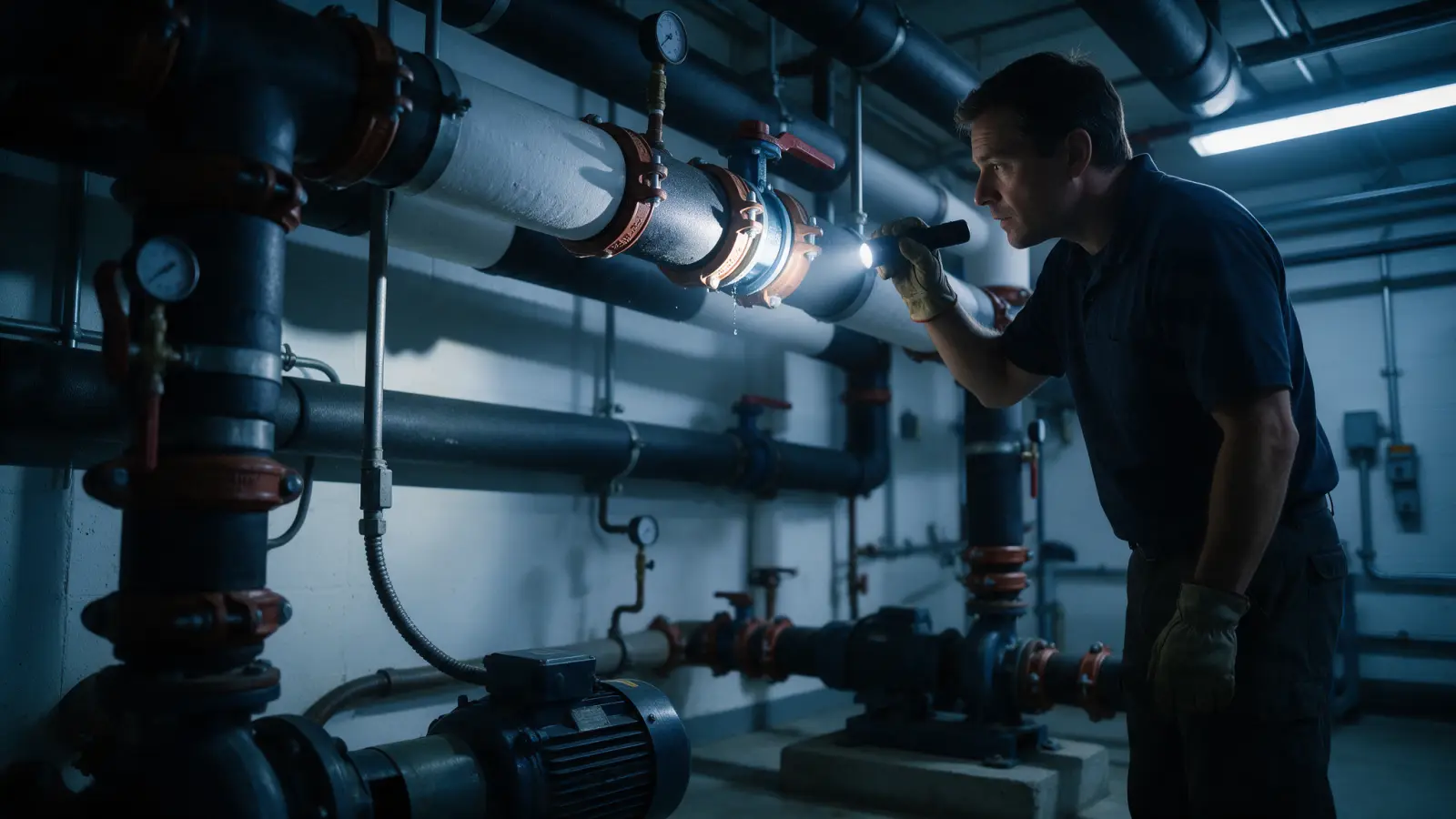
What is chilled water and HVAC pipe leak repair?
Larger commercial buildings move heating and cooling around in water. A chiller or cooling plant makes chilled water that circulates to air handlers and fan coils. A boiler or heat pump heats water that circulates to coils and radiators. These closed hydronic loops run through mechanical rooms, risers, ceiling spaces and shafts across the whole building, often with hundreds of valves, couplings and coil connections.
HVAC pipe leak repair finds and fixes leaks in that piping. That includes chilled water, condenser water, heating hot water and glycol loops, plus the valves, strainers, coils and connections on them. The job has two goals that pull against each other: stop the leak properly, and keep as much of the building comfortable as possible while it's done. Good repairs isolate the smallest possible section, protect the system's water treatment, and look at why the pipe failed so the next pinhole doesn't follow a month later.
Leaks on cooling towers and boilers themselves are covered separately under cooling tower and boiler leak repair.
Which HVAC water systems leak, and how do they differ?
| System | What it does | Leak clues |
|---|---|---|
| Chilled water | Carries cold water from the chiller to cooling coils. | Easily confused with condensation from failed insulation. True leaks drip even when the pipe surface is dry. |
| Heating hot water | Carries heated water from boilers or heat pumps to coils and terminals. | Mineral crust at joints, warm wet spots, white residue on valves. |
| Condenser water | Moves heat from the chiller to a cooling tower. Open to air at the tower. | Higher corrosion and scaling risk. Tower makeup water use climbs. |
| Glycol loops | Antifreeze mix for coils exposed to freezing air. | Sticky or slick residue, a sweet smell, dropping glycol levels. |
How are hydronic leaks repaired?
Find it and isolate it
The leak is traced from where water appears back to the pipe, which may be several feet away along insulation or a hanger. Wet insulation is opened to see the pipe itself. Then the nearest isolation valves are closed so only a small section has to be drained. If valves are missing or don't hold, a pipe-freezing kit can form a temporary ice plug on either side of the leak so the rest of the loop stays full.
Repair the failure
- Grooved couplings. Leaking couplings usually get new gaskets, properly lubricated, and the housing torqued to spec.
- Pinholes and corroded sections. The damaged section is cut out and replaced. Repair clamps are a temporary measure only.
- Valves. Weeping stems are repacked. Valves that won't seal are replaced.
- Coils. Leaking coil tubes are plugged or the coil replaced, depending on how many tubes have failed.
- Threaded and soldered joints. Remade with new fittings, not just sealant on the outside.
Refill, vent and treat
After the repair, the section is refilled, air is purged from high points, and the loop's water chemistry is checked. Glycol concentration is restored on glycol systems. Drained glycol must be collected and disposed of properly, not dumped down a drain.
Preventing the next leak
Hydronic leaks are often a symptom of the water inside the pipes. Regular water treatment testing, working air separators and expansion tanks, and fixing small leaks quickly all keep oxygen and fresh makeup water from feeding corrosion. When a corroded section comes out, ask for it to be cut open and photographed. What the inside looks like tells you whether you're dealing with a one-off failure or a loop-wide problem.
What are the warning signs of an HVAC pipe leak?
- Stained ceiling tiles near mechanical rooms, risers or fan coils.
- Makeup water use rising on a closed loop that shouldn't need much.
- White or green crust on couplings, valves and fittings.
- Wet, sagging or moldy pipe insulation.
- Zones that lose heating or cooling as system pressure drops.
- Gurgling sounds or air in coils as air enters through a leak.
- Air handler drain pans overflowing or water under units.
- A system pressure gauge that keeps dropping and needs topping off.
What causes HVAC pipe leaks?
- Corrosion. Poor water treatment, oxygen getting into the loop and dissimilar metals all corrode pipe from inside, ending in pinholes.
- Microbiologically influenced corrosion. Bacteria in poorly treated water can cause pitting, especially in low-flow or dead-leg sections.
- Gasket aging. Grooved coupling gaskets harden and lose their seal over years of temperature cycling.
- Erosion. High water velocity and turbulence wear through elbows and fittings.
- Freeze damage. Coils exposed to outside air can freeze and split during cold snaps if dampers fail or glycol is weak.
- Condensation mistaken for a leak. Chilled water pipes with torn vapor barriers sweat heavily in humid weather. It drips like a leak but needs insulation repair, not pipe work.
What can you check before calling?
- Note which system is near the leak, if pipes are labeled: CHWS, CHWR, HWS, HWR and so on.
- Check the loop pressure gauge and the makeup water meter, and write down the readings.
- Feel whether the pipe surface is dry, which suggests a leak, or wet all over, which suggests condensation on chilled water.
- Put a bucket or tray under the drip and protect anything below with plastic.
- Find out whether a water treatment company services the loops, and when they last tested them.
Pro tip: log the makeup meter
A weekly reading of the closed-loop makeup water meter is one of the cheapest leak detectors a building can have. Any steady increase means water is leaving somewhere.
Warning: hot water systems scald
Heating hot water and steam can cause serious burns. Don't open valves, loosen fittings or remove insulation on hot lines. Leave it to the mechanical crew.
What happens during the specialist's visit?
- Trace the waterFrom the stain or drip back to the actual pipe, coil or fitting.
- Confirm leak vs condensationInsulation is opened and the pipe surface checked.
- Plan isolationValves are identified, or a freeze plug planned, and affected zones and timing agreed.
- RepairGaskets, pipe sections, valves or coil tubes are repaired or replaced.
- Refill and purgeAir is removed, pressure restored and the repair checked under operating conditions.
- Root cause notesCorrosion signs and water treatment concerns are flagged so you can prevent repeats.
What affects the cost of HVAC pipe leak repair?
| Factor | Effect on the job |
|---|---|
| Pipe size | Larger mains need bigger fittings, more labor and more drain-down. |
| Isolation | Missing or failed valves may mean freeze plugs or a larger drain-down. |
| Access | Ceilings over occupied space, shafts and high mechanical rooms. |
| Fluid | Glycol must be recovered and replaced at the right concentration. |
| Timing | After-hours work to avoid shutting down cooling or heating. |
When is an HVAC pipe leak an emergency?
A split pipe or failed coupling can release a lot of water fast, especially on large mains. Treat it as an emergency when water is pouring through ceilings, reaching electrical or IT rooms, or when heating loss in winter could freeze other pipes. Close the nearest isolation valves if you know them, shut down the pumps serving that loop if it's safe, and call for emergency commercial leak repair.
Server rooms and electrical rooms
Chilled water lines often run near IT and electrical spaces. Any leak above them needs immediate containment and electrical safety checks.
HVAC pipe leak FAQ
Do we have to shut down the whole HVAC system?
Usually not. With working isolation valves, or freeze plugs where valves are missing, most repairs only affect a small section and the zones it serves.
Is it a leak or just condensation?
Chilled water pipes with damaged insulation sweat on humid days. If the pipe surface is wet all along its length, it's likely condensation. A single drip point on an otherwise dry pipe points to a leak.
Why do we keep getting pinhole leaks?
Repeated pinholes usually point to a water chemistry or corrosion problem. Have the water treatment reviewed and consider testing a removed pipe section to find the cause.
Are repair clamps a permanent fix?
They're best treated as temporary. A clamp stops the water, but the corroded pipe underneath keeps deteriorating, so plan a permanent repair.
Can leaking coils be repaired?
A few leaking tubes can often be plugged. When many tubes leak or the coil was freeze-damaged, replacing the coil is the more reliable choice.
What about water from air handler drain pans?
Clogged condensate drains and cracked pans are a common source of "HVAC leaks." Cleaning the drain, adding a float switch and repairing the pan usually fixes it.
Related services and areas
Lab, office and light-industrial campuses in Canyon Park and office buildings around North Creek rely heavily on central hydronic systems. For an overview of every leak type, see our guide to commercial property leak repair. Hard-to-find leaks in buried or hidden lines can be located with acoustic and tracer gas detection.