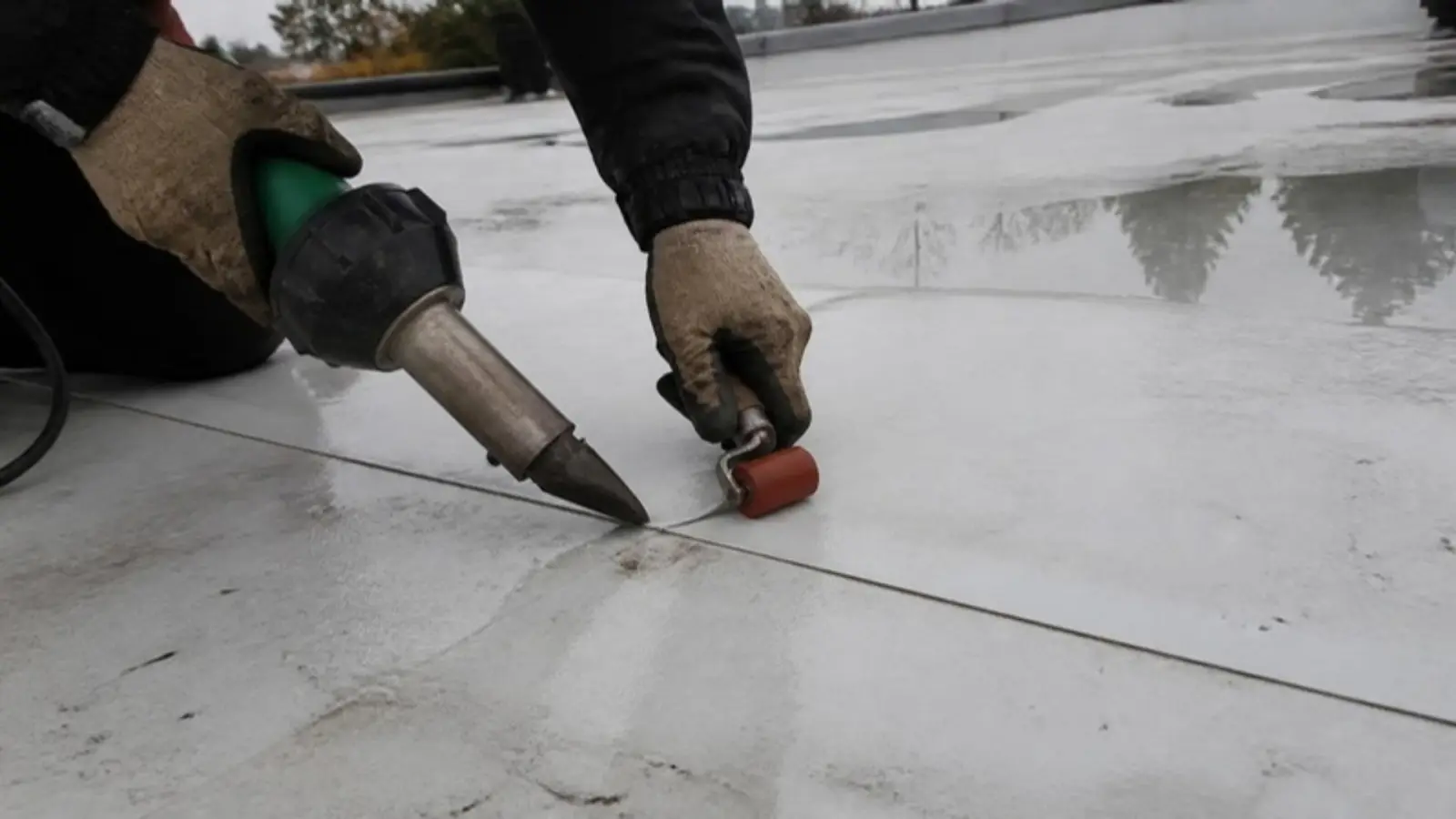
What is flat roof patching and membrane repair?
It's repair of the waterproof layer itself: the sheet or plies covering a low-slope roof. General roof leak work often centers on flashings around equipment and edges. Membrane repair deals with the field of the roof: open seams, punctures, splits, blisters, shrinkage and worn surfacing.
The goal is a patch that becomes part of the membrane, not a lump sitting on top of it. That means the same material family, a cleaned and prepared surface, the right overlap past the damage, and a seam that's tested after it cools or cures. A good patch on a sound roof lasts as long as the membrane around it. A bucket of roofing tar on a single-ply sheet usually lasts until the next big storm.
Which membrane do you have, and how is it patched?
The membrane type decides everything about the repair. If you don't know what's on your roof, the color and texture usually give it away, and the roofer can confirm it with a small sample.
| Membrane | How to recognize it | How it's patched |
|---|---|---|
| TPO | Smooth single-ply sheet, usually white, with hot-air welded seams. | Surface cleaned and prepped, then a TPO patch heat-welded with rounded corners. |
| PVC | Smooth single-ply, often white or gray. Common over kitchens because it resists grease. | Heat-welded PVC patch. TPO and PVC can't be welded to each other. |
| EPDM | Black synthetic rubber sheet, seams joined with tape or adhesive. | Cleaned and primed, then a cured cover tape or EPDM patch with lap sealant at the edges. |
| Modified bitumen | Asphalt rolls with a granule or smooth cap sheet, torched, cold-applied or self-adhered. | Granules embedded or removed, then a new cap sheet piece torched or adhered over the damage. |
| Built-up (BUR) | Layers of felt and hot asphalt, often topped with gravel. | Gravel cleared, damaged plies cut out, then new felts and asphalt stripped in and gravel restored. |
How is a membrane patch done right?
Cleaning and preparation
Weathered membranes carry a film of dirt, chalking and oxidation that stops welds and adhesives from bonding. Roofers scrub the area and use a membrane-specific cleaner or primer. On older TPO and PVC they make a test weld first, because a sheet that has aged in the sun may not accept a new weld.
Sizing the patch
A patch has to extend well past the damage on every side, with rounded corners so the edges don't lift. When several punctures or a long open seam sit close together, one larger patch or a cover strip beats a cluster of small ones.
Welding, adhering and testing
Thermoplastic patches are welded with a hand or robotic hot-air welder. Once cooled, every inch of the seam is checked with a seam probe, a blunt hook that catches any unbonded spot. Adhered patches on EPDM and modified bitumen are rolled in with firm pressure and their edges sealed.
Patch, section or roof?
If moisture readings or a core cut show wet insulation under the damage, that section of membrane comes up so the wet board can be replaced. If wet areas are widespread, a moisture survey with infrared thermography maps the whole roof before anyone prices a bigger repair.
What are the warning signs of membrane damage?
Most of these are visible from a roof walk, long before the ceiling shows a stain:
- Seam edges lifting or "fishmouths," small open tunnels where a lap has pulled apart.
- Punctures, cuts or screw holes around rooftop units and service paths.
- Blisters or bubbles in modified bitumen or built-up roofs, especially ones that crack.
- Membrane pulling tight at corners and curbs, a sign of shrinkage called bridging.
- Reinforcing scrim showing through worn spots on TPO or PVC.
- Bare patches where cap sheet granules have washed away.
- Dirt rings that mark where water ponds after every rain.
- Spongy or soft spots underfoot, which usually mean wet insulation below.
Why do flat roof membranes fail?
- Ponding water. Water that sits for days loads seams and speeds up aging. Flat areas, sagging decks and slow drains make it worse.
- Weak original seams. A seam welded too cold or adhered on a dirty surface may hold for years, then open in a cold snap.
- Thermal movement. Membranes expand and contract daily. Over time that stresses seams, corners and attachment points.
- Sun and age. Single-ply sheets lose flexibility, and asphalt roofs dry out and crack as their surfacing wears away.
- Punctures. Dropped tools, screws and heavy foot traffic from HVAC and other trades.
- Grease and chemicals. Kitchen exhaust can soften and degrade some membranes. That's why restaurant roof leaks often trace back to the area around the exhaust fan.
- Wind. Mechanically fastened single-ply roofs can flutter in strong wind, working fasteners loose and tearing at the plates.
Flashings at curbs, drains and walls are a separate failure point. Those are covered under commercial roof leak repair.
What can you check before the roofer arrives?
Stick to safe access points, stay well back from roof edges and skylights, and stay off the roof when it's wet or icy. Membranes get slippery fast.
- Photograph the area above the leak, plus any seams, patches or damage nearby.
- Look for dirt rings and standing water, and note how long it stays after rain.
- Check around kitchen exhaust fans for grease on the roof surface.
- Note any recent rooftop work by HVAC, solar, signage or telecom crews. Their path is a common puncture zone.
- Find any warranty paperwork listing the membrane manufacturer and installer.
Pro tip: don't step on blisters
Walking on blisters can rupture them and let water into the plies. Mark them in your photos and walk around them.
Warning: asphalt products on single-ply roofs
Asphalt-based cements and some sealants damage TPO, PVC and EPDM, and can make a later welded repair impossible. If a temporary fix is needed, use a product the membrane manufacturer approves.
What happens during the repair visit?
- Identify the systemMembrane type, thickness, attachment method and any warranty that sets rules for materials or installers.
- Inspect the fieldA walk of the seams, laps and traffic areas, not just the spot above the leak.
- Check for moistureMeter readings and, if needed, a small core cut to see whether insulation under the damage is wet.
- Prepare the surfaceCleaning, priming or granule removal, plus a test weld on older thermoplastic sheets.
- Patch or replace the sectionPatches welded or adhered. Wet insulation is cut out and replaced before the membrane closes over it.
- Probe and documentSeams probed after cooling, then photos and a short note on other weak spots worth watching.
What affects the cost of membrane repair?
| Factor | Effect on the job |
|---|---|
| Membrane age | Weathered sheets need more prep, and some no longer weld. |
| Number of repairs | One puncture versus long runs of open seams. |
| Wet insulation | Opening the roof to replace board adds material and time. |
| Surfacing | Gravel on BUR roofs must be cleared and put back. |
| Warranty materials | Approved products or installers may be required. |
When is membrane damage an emergency?
A membrane torn open or peeled back by wind is urgent. So is a large section flapping loose, or water coming through several ceilings at once. Wind gets under a loose sheet and keeps tearing it, so the damage grows by the hour. Call for emergency commercial leak repair to get the loose section secured and temporarily sealed.
Stay off a loose membrane in wind
A sheet that lifts in a gust can knock a person off balance near the roof edge. Wait for the crew.
Flat roof membrane FAQ
How long does a flat roof patch last?
A properly welded or adhered patch in matching material should last about as long as the membrane around it. Caulk, tar or tape slapped over a single-ply roof is a stopgap and should be replaced with a real patch.
Can an old TPO roof still be patched?
Often, yes, but weathered TPO doesn't always accept a new weld. Roofers clean the surface and make a test weld first. If it won't hold, they use a different repair method or recommend replacing that section.
What is a fishmouth on a roof seam?
It's a small wrinkle or opening at the edge of a lap, shaped like an open mouth. Water and wind get inside it, so it's cut, flattened and covered with a patch.
Do all roof blisters need repair?
Not always. Small, intact blisters are often monitored. Blisters that are cracked, growing, or sitting where people walk are cut out and repaired before they let water in.
Can a new membrane go over the old one?
Sometimes. A recover can work when the deck and insulation are dry and sound, but building codes limit how many roof layers are allowed. Wet areas found in a moisture survey have to be removed first.
Is a coating the same as a membrane repair?
No. A coating protects and extends a roof that's basically sound. Open seams and punctures still need proper patches first. See commercial waterproofing and roof coatings for when a coating makes sense.
Related services and areas
Membrane repairs come up often on strip-center roofs around Thrasher's Corner and on the smaller flat roofs along the West Bothell corridor. For a leak that may not be coming from the roof at all, our Bothell commercial leak specialists can point you to the right trade.