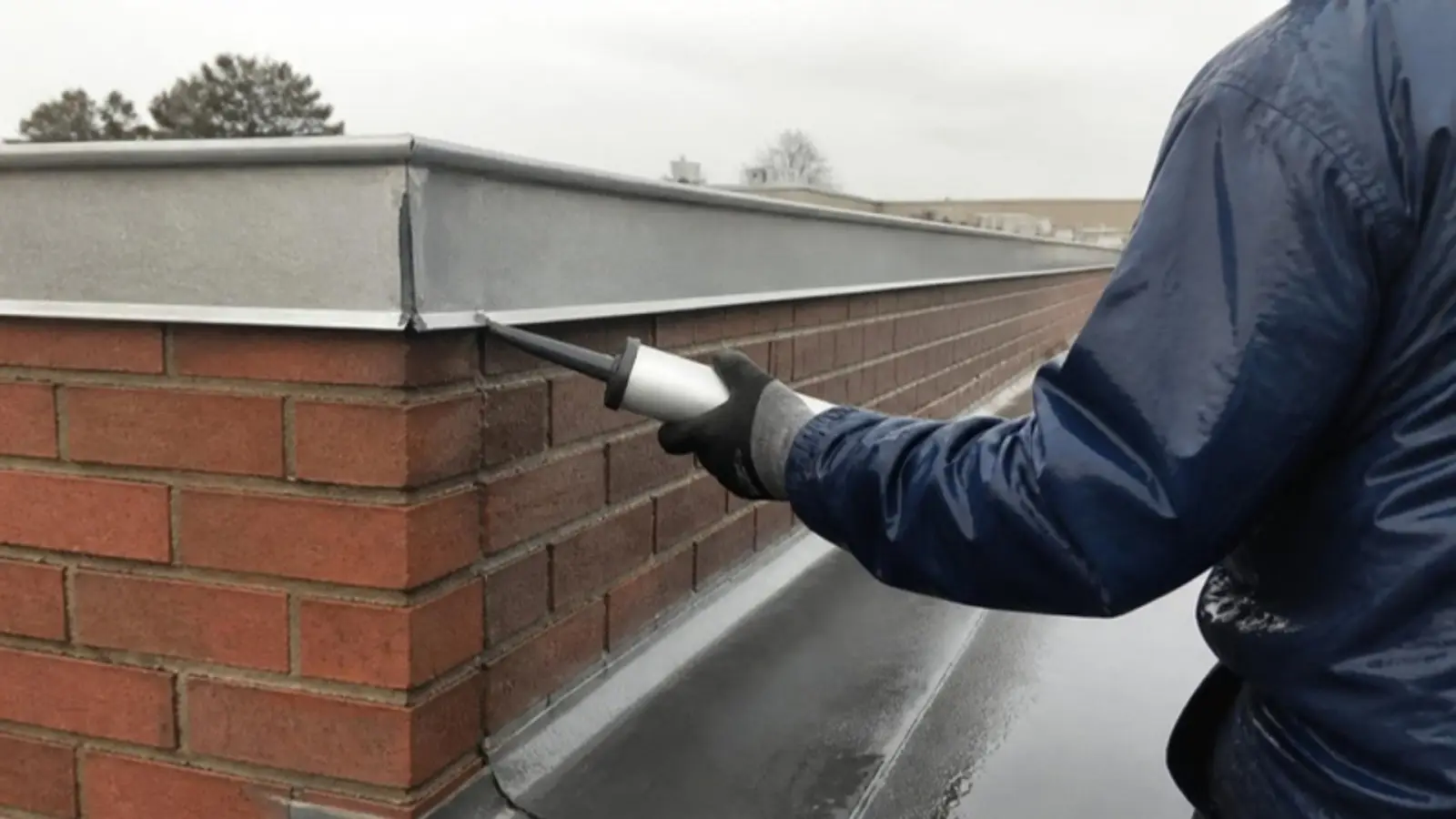
What is parapet wall and flashing repair?
A parapet is the short wall that rises above the roof line around the edge of many commercial buildings. It shelters the roof edge and hides equipment, but it also creates the most complicated waterproofing transition on the building. Water has to be shed off the top of the wall, kept out of the wall itself, and stopped where the wall meets the roof membrane.
Parapet and flashing repair fixes each of those layers. The coping caps the top of the wall. Counterflashing overlaps the top of the roof's base flashing and is tucked into a reglet or mounted with a termination bar. Base flashing runs the roof membrane up the wall. Through-wall flashing inside masonry walls catches water that soaks into the wall and sends it back out through weeps. A leak at the top of an exterior wall usually means one of these layers has failed.
Because these layers overlap, a stain on the inside of the wall doesn't tell you which one failed. A coping joint, a loose counterflashing and a split base flashing corner can all put water in the same place. That's why parapet repairs start by checking each layer in order, from the top of the wall down, instead of resealing whatever looks worst from the roof.
How are parapet and flashing leaks repaired?
Coping caps
Metal coping is installed in sections with joints that move with temperature. Those joints are sealed with cover plates, splice plates or sealant, and they open over time. Repairs range from resealing joints to re-securing loose sections on cleats, or adding a waterproof underlayment under the coping so any water that gets past a joint can't reach the wall. Stone and concrete copings need their mortar joints and sealant renewed.
Counterflashing and reglets
Counterflashing that has pulled out of its reglet, or that relies on a dried-out sealant bead, lets water run behind the base flashing. It's reset, re-fastened and sealed, or replaced with a two-piece system that can come off for future roof work without damaging the wall.
Base flashing
Base flashing is the membrane turned up the wall, typically eight inches or more above the roof surface. Where it has shrunk, split at corners, or come loose from the wall, it's stripped back and rebuilt with new membrane, fully adhered and terminated under the counterflashing.
Wall body and through-wall flashing
If the parapet is brick or block, water may be getting into the wall face itself through cracked mortar or porous masonry. Repointing, masonry sealers and, in larger repairs, new through-wall flashing with weeps get that water back out.
What are the warning signs of a parapet leak?
- Stains or wet drywall at the very top of an exterior wall, just under the roof deck.
- Leaks that only appear in wind-driven rain from one direction.
- Coping sections that are loose, dented or have gaps at the joints.
- Counterflashing pulled away from the wall or held on only by caulk.
- Base flashing that is wrinkled, split at inside corners or sagging off the wall.
- White efflorescence, spalling or cracked mortar on the parapet face.
- Rust stains running down the wall from coping fasteners.
- Peeling paint or bubbling plaster on the inside face of the parapet.
What causes parapet walls to leak?
- Joint movement. Metal coping expands and contracts every day. Sealant at the joints wears out and the sections work loose from their cleats.
- Flat coping tops. Coping without a slight slope lets water sit on top and work through the joints. It should pitch toward the roof.
- Sealant used as flashing. Counterflashing held on with a bead of caulk, instead of a reglet or termination bar, fails as soon as the bead dries out.
- Short base flashing. Flashing that doesn't run high enough up the wall can be overtopped when drains back up and water ponds against the parapet.
- Masonry absorption. Brick and block soak up water during long rains. Without working through-wall flashing and weeps, that water ends up inside.
- Building movement. The wall and the roof deck move differently. Base flashing that's fastened rigidly to both can tear at the corner.
When the roof membrane itself is damaged near the wall, the repair overlaps with flat roof membrane repair. When the leak shows up around windows lower on the wall, it's more likely a window or facade waterproofing issue.
What can you check before calling?
Parapets are at the roof edge, the most dangerous place on the roof. Only check from a safe position with fall protection, or limit yourself to what you can see from inside and from the ground.
- Inside, note exactly how far down the wall the stain starts. Stains right under the deck point to the coping or flashing.
- Record the wind direction during storms when it leaks. Leaks on just one side of the building point to that side's parapet.
- From the ground, look for coping sections that sit crooked or show daylight at the joints.
- Look for efflorescence, cracked mortar or rust streaks on the outer face of the wall.
- Check whether roof drains near that wall are clear, since ponding against a parapet can overtop the base flashing.
Pro tip: check the inside corners
The inside corners where two parapet walls meet are where base flashing most often splits. If your stain is near a building corner, mention it when you call.
Warning: more caulk isn't the answer
Layering sealant over coping joints and counterflashing can trap water behind it and hide the real failure. Lasting repairs rebuild the flashing so it laps correctly.
What happens during the specialist's visit?
- Inside inspectionThe specialist traces the stain to a section of wall and checks how high it starts.
- Coping and jointsCoping is checked for slope, loose sections and failed joints. Some sections may be lifted to look underneath.
- Counterflashing and base flashingTerminations, laps, corners and flashing height are inspected along the suspect wall.
- Masonry checkBrick or block walls are checked for open joints, cracks and blocked weeps.
- Water testIf several suspects remain, one component at a time is water-tested, starting low and working up.
- Repair and reportThe failed layer is rebuilt, then photos and notes on the other walls are provided for planning.
What affects the cost of parapet and flashing repair?
| Factor | Effect on the job |
|---|---|
| Linear footage | One coping joint versus a full wall run. |
| Wall material | Masonry repair adds repointing and flashing work. |
| Access | Exterior work may need a lift or scaffolding. |
| Coping type | Custom-formed metal or stone coping costs more to match. |
| Roof tie-in | Rebuilding base flashing means opening the roof membrane. |
When is a parapet problem an emergency?
Loose coping sections are a falling hazard, especially over sidewalks, entries and parking. Cracked or bulging masonry parapets can shed brick in high wind. If water is pouring down an interior wall onto electrical outlets or panels, shut off the affected circuits and call for emergency commercial leak repair.
Keep people clear below loose coping
Tape off the area under any coping or masonry that looks loose until it's secured.
Parapet and flashing FAQ
Why does my wall leak only during some storms?
Coping joints and counterflashing are most exposed to wind-driven rain. When storms come from the direction that hits a failed joint, water gets in. Other storms miss it entirely.
How high should base flashing go up a parapet?
A common minimum is eight inches above the finished roof surface, but manufacturer requirements and the roof's drainage can call for more. Flashing that's too short is easily overtopped by ponding water.
Can coping be repaired without replacing it?
Often, yes. Resealing joints, adding splice plates, re-securing sections and adding an underlayment can stop leaks. Badly dented, corroded or flat coping is better replaced with a properly sloped profile.
Is this a roofing job or a masonry job?
It can be either, or both. Flashing tied into the roof membrane is roofing work. Cracked mortar and through-wall flashing are masonry or waterproofing work. A good inspection tells you which trade to bring in.
Will fixing the parapet affect my roof warranty?
Base flashing is part of the roof system. If your roof is under a manufacturer warranty, check whether the repair must use approved materials or be done by an authorized contractor.
Should parapets be inspected regularly?
Yes. Include the coping, counterflashing and base flashing in every roof inspection, and look at the outer wall face from the ground for loose coping, cracks or efflorescence.
Related services and areas
Older masonry storefronts in Downtown Bothell often have brick parapets with aging coping, while office buildings around North Creek tend to have metal coping over panel or curtain walls. For every other kind of leak, start with commercial leak repair Bothell WA.