The short answer: compare usage with the same period last year, run an after-hours meter test, then check the cheap suspects first: running toilets and urinals, irrigation and water-using equipment. If the meter still moves with everything off, the leak is likely on a buried service line or under the floor.
How do you read a commercial water bill for leak clues?
Most water bills show consumption for the billing period in units such as hundreds of cubic feet (CCF) or gallons. Many sewer charges are calculated from water use too, so a leak can inflate both lines. Before assuming a leak, rule out simple explanations:
- Compare with the same billing period last year, not just last month. Seasonal irrigation and cooling make summer bills higher.
- Check whether the reading was actual or estimated. An estimated read followed by an actual one can create a catch-up spike.
- Think about changes in use: a new tenant, a new restaurant, extended hours, construction or a new irrigation zone.
- Look at the trend. A sudden step up suggests a new failure. A slow climb over many months suggests a leak that's growing.
How do you test for a leak with the meter?
Find the meter, which is usually in a box near the street or property line, and look for the low-flow indicator, a small dial or triangle that turns with very small flows. Then:
- Pick a quiet timeAfter closing or before opening, when nothing is scheduled to use water.
- Turn everything offFixtures, ice machines, dishwashers, irrigation, cooling tower makeup, water softeners and process equipment.
- Watch the indicatorIf it moves, water is going somewhere.
- Close the building mainIf the indicator stops, the leak is inside. If it keeps turning, the leak is on the line between the meter and the building, or on a branch such as irrigation.
- Try an overnight readWrite down the meter reading at closing and again at opening. Any usage overnight is a red flag.
What usually causes a high commercial water bill?
| Cause | How to spot it |
|---|---|
| Running toilets and urinals | Listen in restrooms after hours. Look for water trickling into bowls. |
| Dripping faucets and sprayers | Check kitchens, service sinks and sensor faucets that don't shut off. |
| Irrigation problems | Broken heads, stuck valves, wet beds or controllers running too often. |
| Cooling tower overflow | Water running from the overflow pipe or a blowdown valve stuck open. |
| Equipment | Ice machine drains running constantly, water softener regeneration problems, reverse osmosis reject water. |
| Water heater relief valve | Water at the relief valve discharge pipe or floor drain. |
| Closed-loop leaks | Heating or chilled water makeup meters climbing. |
| Under-slab leaks | Meter moving with fixtures off and the main open. Warm spots on the floor. |
| Service line leaks | Meter moving with the building main closed. Soggy ground or sinking pavement. |
Why should you check fixtures first?
Because they're the most common cause, and the cheapest to fix. A flush valve with a worn diaphragm can let water run through a toilet or urinal around the clock. In a building with dozens of restroom fixtures, a few failing ones can add up quickly on both the water and sewer charges. Walk every restroom after hours and listen. Then put a few drops of food coloring in any tank-type toilets and see if color shows up in the bowl without flushing. Our commercial faucet and flushometer repair page explains what each symptom means.
What about irrigation and plant equipment?
Irrigation is a frequent culprit on commercial sites. Leaks often hide in planted beds or under bark where no one walks, and they run every night. Shut irrigation off at its own valve and repeat the meter test. If the loss stops, have the system inspected zone by zone.
On buildings with central plants, check the cooling tower. A float or makeup valve that doesn't shut off sends water straight down the overflow, and a stuck blowdown valve drains treated water all day. Daily readings of the tower's makeup meter, compared against the weather and cooling load, show problems quickly. See cooling tower and boiler leak repair for details.
What if the leak is hidden underground or under the slab?
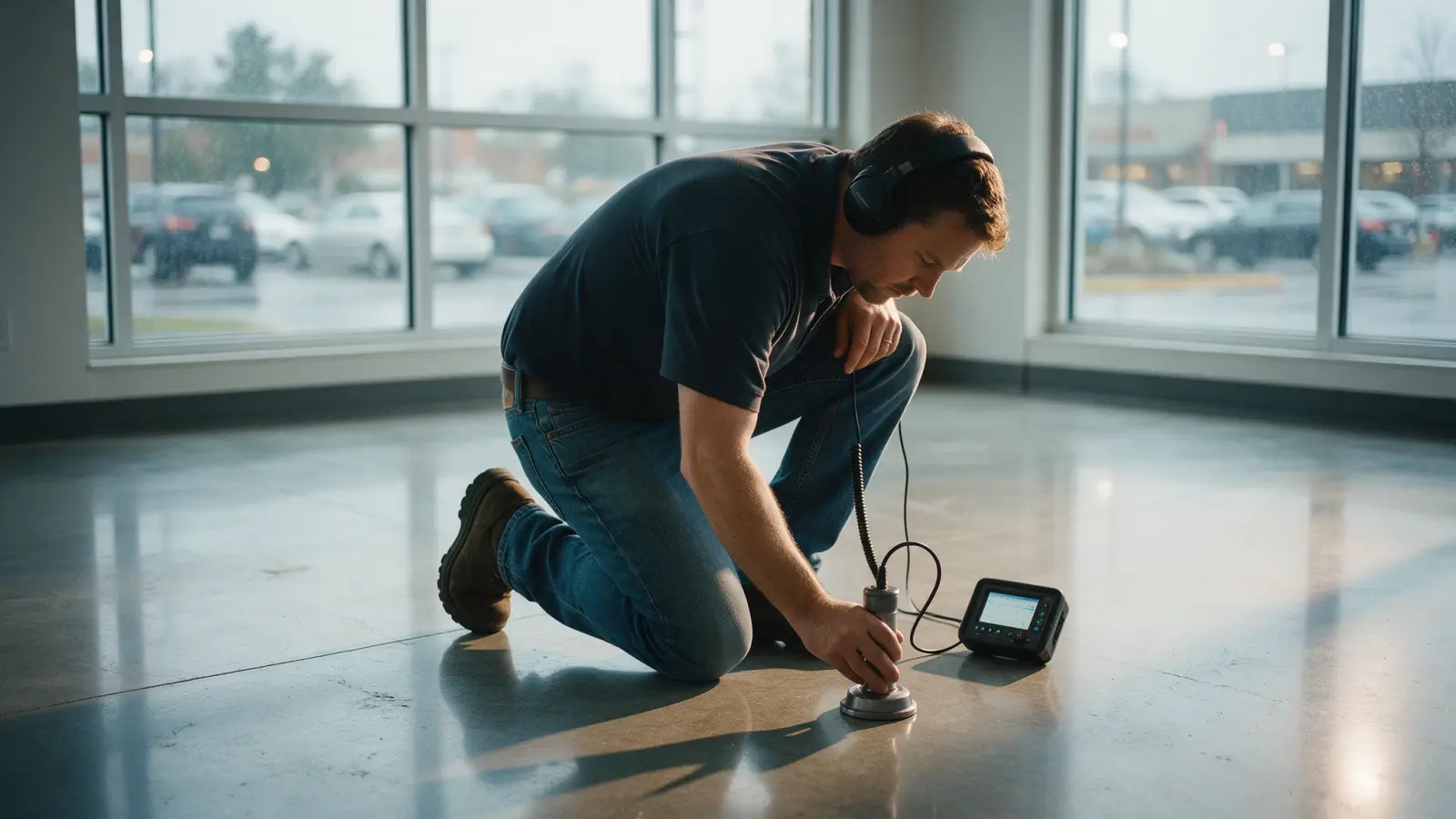
If the meter moves with fixtures, irrigation and equipment all off, the leak is on a pressurized line you can't see. If closing the building main stops the meter, the leak is inside, often under the slab. If it keeps moving, the leak is on the service line outside. Either way, the next step is professional location. Specialists trace the line, then pinpoint the leak with ground microphones, correlators or tracer gas, so the repair needs one small opening. Read more under slab leak detection and main water line repair.
Warning: don't wait for the next bill
Leaks under slabs and parking lots can soften soil and undermine paving or floors over time. Once a meter test confirms a hidden leak, schedule location promptly.
Can you get money back on the bill?
Some water and sewer providers offer leak adjustments or credits once a leak has been repaired and documented, and some offer sewer credits for water that evaporates in cooling towers or is used for irrigation through a separate meter. Policies vary by provider. Keep the repair invoice, photos and before-and-after meter readings, and ask your provider what applies.
How do you catch the next leak earlier?
- Read the main meter at the same time each month and keep a simple log.
- Do an overnight meter test every quarter.
- Consider submeters for irrigation, cooling towers and major tenants.
- Track makeup water on closed heating and cooling loops weekly.
- Ask staff to report running fixtures right away.
Pro tip: set an alert
Some utilities and smart meters can alert you to continuous flow. Ask your provider whether it's available for your account.
When the source is still a mystery after these steps, our commercial leak repair services connect you with a local specialist who can find it.
High water bill FAQ
Can a single running toilet really raise the bill?
Yes. A fixture that runs continuously wastes water around the clock, and many sewer charges are based on water use, so it can add up quickly.
Is the water company responsible for leaks?
Generally the utility handles the main and the meter, and the owner handles the line from the meter to the building and everything inside. Check with your provider.
What if the meter itself is wrong?
Meter errors happen but are uncommon. If tests show no leak and usage still doesn't make sense, ask the utility to verify the read or test the meter.
Why did my bill jump after a cold snap?
Freezing can split pipes, hose bibs and irrigation components. Check exposed piping and irrigation backflow assemblies after any hard freeze.
How fast should a hidden leak be found?
As soon as practical. Besides the cost, water from a pressurized leak can damage soil, slabs and paving over time.