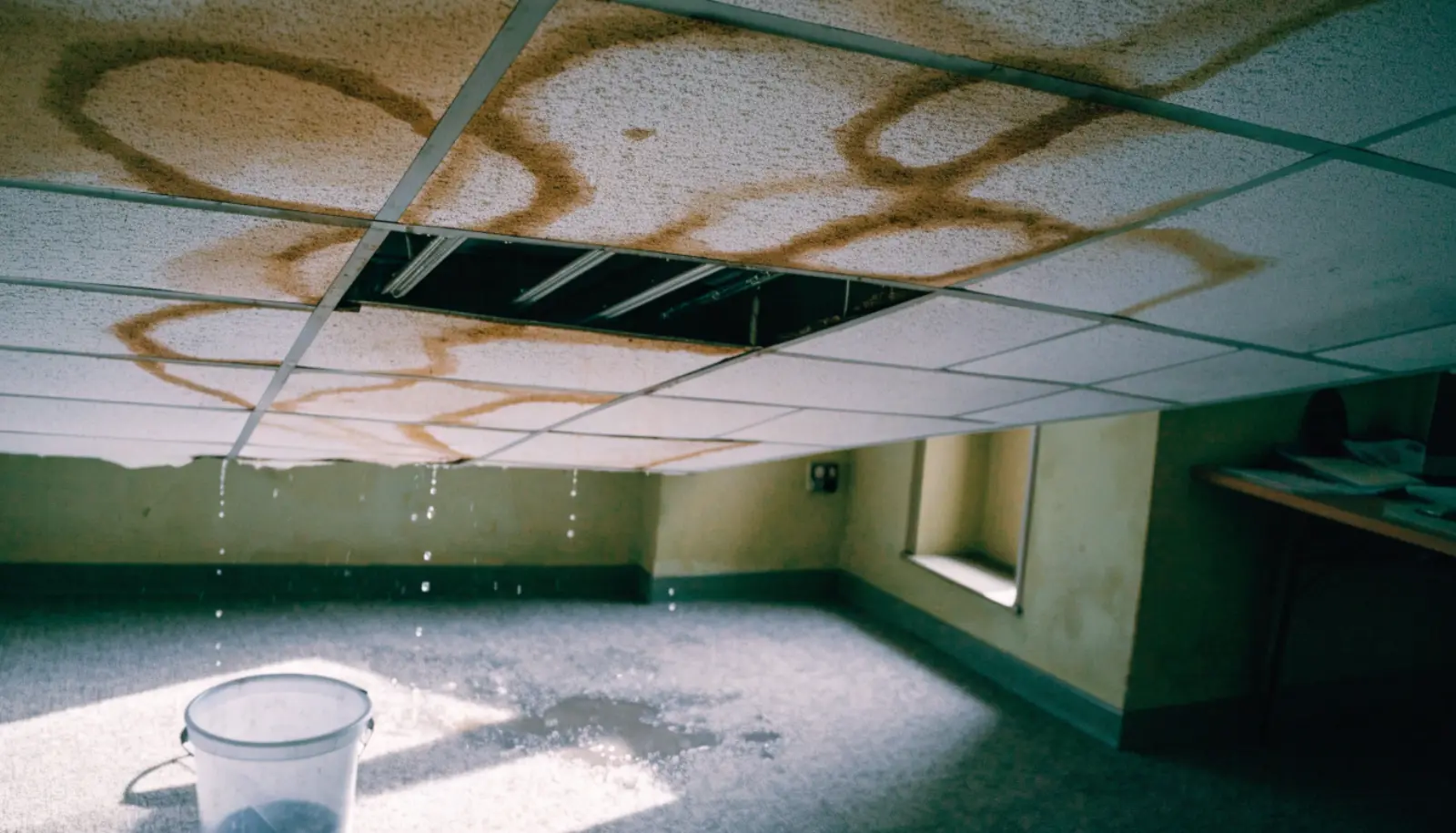
The short answer: watch when the leak happens, use the water meter to rule plumbing in or out, then trace the water up and upslope from where it appears. Most leaks fall into one of four groups, and each group has a short list of usual suspects.
Step 1: How do you make the area safe first?
Before investigating, deal with the hazards. Keep people away from water near electrical panels, outlets and light fixtures, and away from ceilings that sag or bulge, because those can be holding pooled water. If a pipe is clearly spraying, close the nearest valve or the building main. Protect equipment and stock with plastic and buckets.
Then resist the urge to clean everything up. Stains, wet ceiling tiles and the outline of a puddle are evidence. Photograph them with timestamps, mark the edges of stains with painter's tape and the date, and leave what you safely can in place until the source is known. If water is moving fast, follow the steps on our emergency leak page first.
Step 2: What does the leak's timing tell you?
The single most useful clue is when the leak happens. Start a simple log: date, time, weather, wind direction, and what equipment or fixtures were running. After a few events, a pattern usually shows up.
| When it leaks | Most likely group |
|---|---|
| During or right after rain | Roof, walls, windows or storefront glass. |
| Only in wind-driven rain from one direction | Walls, windows, coping or curtain wall on that side. |
| A day or two after heavy rain, lasting for days | Groundwater through foundations or below-grade walls. |
| In dry weather, constantly | A pressurized supply or hydronic line. |
| Only when fixtures or equipment run | Drains, fixture connections or equipment. |
| Cool, damp mornings, spread widely | Condensation on cold pipes, ducts or metal roofs. |
Step 3: How do you rule plumbing in or out with the water meter?
The water meter is the cheapest leak detector in the building. Do this test after hours, when the building is quiet:
- Shut everything offTurn off fixtures, ice machines, dishwashers, cooling tower makeup and irrigation, anything that uses water.
- Watch the low-flow indicatorMost meters have a small dial or triangle that spins with even tiny flows. Watch it for several minutes.
- Close the building mainIf the indicator is moving, close the building's main valve. If it stops, the leak is inside the building. If it keeps moving, the leak is between the meter and the building.
- Split hot from coldClosing the water heater's cold inlet and rechecking can show whether the loss is on the hot side, a common clue for leaks under a slab.
A meter that stays still with everything off points away from pressurized plumbing and back toward rain, groundwater, drains or condensation.
Step 4: How do you trace water back toward its source?
Water flows down and along whatever it touches, so the source is almost always above and upslope of where it appears. Work outward from the wet spot:
- Lift ceiling tiles near the stain, using a flashlight, and look at the deck, pipes, conduits and ducts above. Look for the wettest or highest point.
- On steel roof decks, water runs along the flutes, so look along the direction the deck ribs run.
- Follow wet pipe insulation back to where it's wettest. Water travels inside insulation for long distances.
- Note what sits directly above the area on the roof: units, curbs, drains, skylights, parapets.
- For lower floors, check the units or suites directly above, starting with bathrooms and kitchens.
Pro tip: use a cheap moisture meter
A basic pin or pinless moisture meter helps you map how far drywall and ceiling materials are wet. The wettest high point is usually the best clue to direction.
Step 5: What are the usual suspects in each group?
Roof and envelope
On low-slope roofs, check curb flashing at rooftop units, pipe boots, drain clamping rings, open seams and the base of parapets. Clogged drains that back water up against seams are a common trigger. Our commercial roof leak repair page explains each detail. On walls, look at window perimeter sealant, sill flashing and blocked weeps.
Pressurized plumbing and HVAC
Check fixture supply connections, water heater relief valves, ice machine and dishwasher lines, grooved couplings and valves on hydronic piping, and anywhere pipes pass through walls. Rising makeup water on a closed heating or cooling loop is a strong clue.
Drains
Slow drains, odors and leaks that happen only when fixtures run point to drain lines, floor sink connections, toilet wax rings or shower pans in the space above.
Below grade
Look for efflorescence, damp cold joints, tie holes and the wall-floor joint. Outside, check downspouts, grading and drain outlets near the wet area.
Warning: stay off the roof in bad weather
Only go onto a roof with safe access and fall protection, never in rain, wind or ice, and never near skylights. Many roof checks can wait for a dry day or be done by the specialist.
Step 6: How do you confirm the source?
A suspect isn't a source until a test reproduces the leak. For pipes, that's a pressure or isolation test: close valves section by section and see which one stops the loss. For roofs and walls, it's a controlled water test: wet one detail at a time, starting low and working up, while someone watches inside. Never start high, because water running down can trigger a lower leak and fool you.
When you can't safely test, or the evidence points in two directions at once, that's the point to bring in professional commercial leak detection. Tools like infrared, acoustic listening and tracer gas can see what a flashlight can't.
When should you stop and call a specialist?
- Water is near electrical equipment, or a ceiling is sagging.
- The meter test shows a loss but nothing inside is wet, which suggests a buried or under-slab line.
- The same leak has been "fixed" before and came back.
- The leak involves several tenants or units and responsibility is unclear.
- Finding it would mean opening finished walls, floors or roofing.
Bring your leak log, photos and meter readings to the call. They often cut the investigation time in half. For buried lines, acoustic and tracer gas detection pinpoints the spot before digging. For an overview of every leak service, see Bothell commercial leak repair.
Leak-finding FAQ
Why does water appear so far from the leak?
Water follows roof decks, beams, pipes, insulation and conduit until it finds a low point or an opening. On commercial buildings that path can run many feet before it drips.
Can I find a slab leak myself?
You can often confirm one with the meter test and a warm spot on the floor. Pinpointing it usually takes professional acoustic or tracer gas equipment.
How do I tell condensation from a leak?
Condensation forms on cold surfaces, spreads widely and often happens on cool, damp mornings regardless of rain. Leaks usually follow rain or water use and drip from specific points.
Is a thermal camera worth buying?
Basic thermal cameras can help spot damp areas indoors, but results depend on conditions and need confirming with a moisture meter. Professional roof surveys need training and the right timing.
Should I open the ceiling to look?
Lifting drop-ceiling tiles is fine. Cutting drywall, floors or roofing should wait until a test points to a specific spot.